

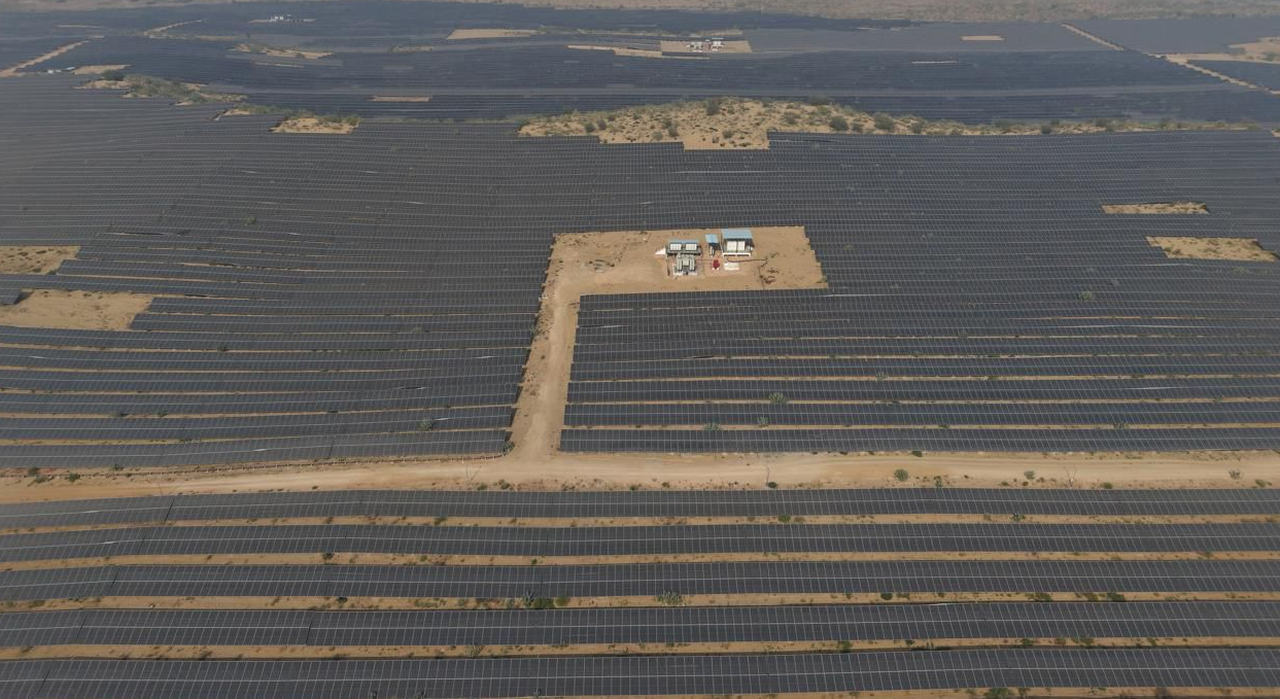
SJVN has achieved the Commercial Operation Date (COD) of its 1,000 MW Bikaner Solar Power Project, marking a major step in strengthening the country’s renewable energy capacity.
Sharing the information, SJVN Chairman and Managing Director Bhupender Gupta congratulated the employees and said the achievement reflects the technical strength of the company and the coordinated efforts of employees, contractors and all stakeholders. He said the project underlines SJVN’s commitment to expanding clean and affordable power generation.
The 1,000 MW solar project is located in Bikaner district of Rajasthan and is being implemented through SJVN’s wholly owned subsidiary, SJVN Green Energy Limited (SGEL). The project is expected to generate 2,454.55 million units of electricity in its first year and about 56,838 million units over a period of 25 years. The maximum usage charges have been fixed at ₹2.57 per unit, helping ensure affordable green power. The electricity generated will be supplied to Rajasthan, Jammu & Kashmir and Uttarakhand.
Director (Personnel) Ajay Kumar Sharma said the project has been developed on around 5,000 acres of outright-purchased land near Village Banderwala in Bikaner district, which is among the highest solar-yield regions in the country. He added that the commissioning of the project makes a significant contribution towards achieving the Government of India’s target of 500 GW of renewable energy capacity by 2030.
Director (Finance) Sipan Kumar Garg said the project has been developed at a cost of ₹5,492 crore and executed under the Domestic Content Requirement (DCR) mode, using domestically manufactured solar photovoltaic cells and modules. He said this supports the Make in India initiative. The project is also expected to reduce carbon emissions by an estimated 27,85,077 tonnes.
Earlier, the foundation stone of the project was laid by the President of India, Droupadi Murmu, in 2023 at Jaipur. The Bikaner Solar Power Project has been developed under the Central Public Sector Undertaking (CPSU) Scheme – Phase II, Tranche III, of the Ministry of New and Renewable Energy, Government of India. Implementation under the DCR mode is expected to strengthen the indigenous solar manufacturing ecosystem further.