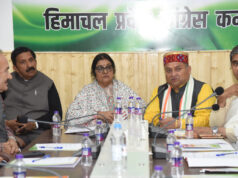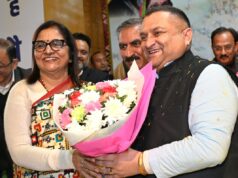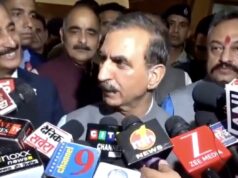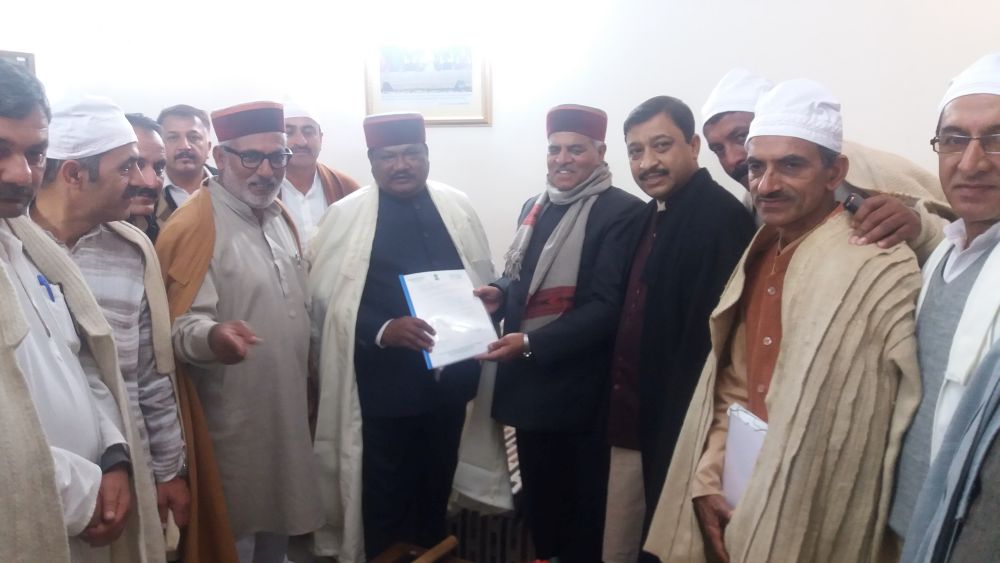

With panchayat and municipal elections looming, the absence of party structure cripples Congress machinery; state president Pratibha Singh warns of serious organisational consequences.
The Himachal Pradesh Congress finds itself in a state of unprecedented disarray, eight months after the party high command dissolved the Pradesh Congress Committee (PCC) in November 2024. Since then, the party machinery has been running headless — without any appointed general secretaries, district presidents, or working committee members. While the Congress remains in power in Himachal Pradesh, it is politically adrift, organizationally weak, and increasingly divided.
State Congress President and former Mandi MP Pratibha Singh has now made a public appeal to the high command for the immediate reconstitution of the HPCC. In a strong statement, she said,
“The executive of the PCC has been dissolved for a long time, due to which organizational work is getting affected. In such a situation, early approval is necessary so that the party structure can be reactivated. Municipal bodies and Panchayati Raj elections are going to be held soon in the state, and appointment of officials is very important so that responsibilities can be fixed.”
Her remarks reflect the growing frustration within the state unit over the delay, and a widening sense of disconnect between the party in Himachal and the central leadership in Delhi.
Power Without Party: Congress Governs But Cannot Organise
It is an irony of Himalayan proportions: the Congress governs Himachal Pradesh but is unable to run its own party structure. Since the HPCC was dissolved in November 2024, no new executive has been appointed. Pratibha Singh remains the only officially designated leader of the Himachal unit. Without a general secretary, working presidents, or even block-level leadership, the Congress in Himachal today exists more on paper than on the ground.
The absence of a party setup has paralysed internal coordination, demotivated ground-level workers, and created a leadership vacuum. “There is no one to assign responsibilities or even take feedback from the field,” says a senior party functionary. “We are in power, but we are not in control.”
Factionalism and Power Struggles Intensify
Behind the delay in reconstituting the HPCC lies the deeper malaise of factionalism. The Congress in Himachal is split between the camps of Chief Minister Sukhvinder Singh Sukhu and PCC President Pratibha Singh. Sukhu, who rose through student politics and organisational work, is seen as trying to consolidate power by sidelining rivals, including loyalists of the late Virbhadra Singh.
On the other hand, Pratibha Singh still commands loyalty in key districts. Her public push for reactivating the PCC has also been read as a veiled message to the Sukhu camp and to 10 Janpath — that the delay is costing the party dearly.
Meanwhile, neither faction appears strong enough to independently control the party — leading to a situation of total inertia.
Natural Calamities, Political Vacuum
The absence of organisational leadership comes at a time when Himachal Pradesh is battling a series of natural disasters. Landslides, floods, and cloudbursts have caused widespread destruction, particularly in Mandi — the constituency represented by Pratibha Singh. Over 100 people have died, and government and private infrastructure worth thousands of crores has been destroyed.
Despite the gravity of the situation, the Congress has failed to launch a united relief campaign. Pratibha Singh has demanded a special economic package from the Centre and acknowledged the limits of the state’s response.
“The state government is engaged in relief and rescue operations despite its limited resources,” she said. “The economy has suffered a severe blow, and a huge relief package is needed to recover from this disaster.”
But the lack of a functioning party network means that the Congress cannot convert its political authority into effective public mobilization or even coordinated disaster response.
High Command’s Apathy Undermining State Unit
Perhaps the most damaging aspect of this crisis is the apathy shown by the Congress high command. Despite being in government and facing elections at the local level, the party’s top leadership has allowed Himachal Pradesh to remain without a PCC for eight months — a period marked by mounting internal differences, disorganised functioning, and growing public disillusionment.
Party insiders reveal that multiple names have been sent to Delhi for approval, but no consensus has emerged, largely due to the Sukhu–Pratibha rivalry. The result is a vacuum that is now beginning to affect governance and could severely damage Congress’s chances in upcoming elections.
Panchayat Elections: Congress Faces Existential Test
With the Panchayati Raj and urban body elections due soon, the Congress may face an embarrassing situation. Without a formal party structure, it lacks mechanisms to identify candidates, coordinate campaigns, or mobilise workers.
In a state where the BJP is aggressively regrouping, the Congress’s inability to put its house in order could lead to a poor showing — one that may have long-term consequences for 2026.
The Himachal Congress today is a ruling party without an organisational soul. Bereft of leadership, split by factions, and overlooked by the high command, it is heading toward political irrelevance unless urgent corrective steps are taken. Pratibha Singh’s public statement is not just a routine request — it is a warning. If the Congress fails to reconstitute the HPCC and rebuild its base in time, it may lose more than just local elections — it may lose the trust of its own cadres.
In Himachal, the clock is ticking. And the Congress is still waiting for Delhi to wake up.