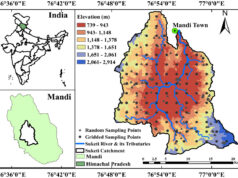


Scientists at the Indian Institute of Technology (IIT) Mandi have carried out an important study on the Beas Basin that clearly identifies areas with high groundwater availability and regions where water scarcity is likely to intensify in the coming years. Using a modern scientific approach based on remote sensing and GIS, the researchers have divided the entire Beas Basin into distinct groundwater zones, preparing a detailed map that is expected to play a key role in policymaking and water management.
According to the findings, the western part of the Beas Basin is the most groundwater-rich region. Areas such as Kangra district, Dehradun, Gopipur, Jwalamukhi, Jawali, Nurpur, the Pong Dam region, lower Dharamshala, and the Una border area fall under very high and high groundwater availability zones. These regions show strong potential for sustained groundwater resources.
The central Beas Basin, which includes Mandi district, Balh Valley, Sundernagar, and Jogindernagar, has been classified under moderate groundwater availability. While these areas are not facing an immediate crisis, the study indicates the need for careful management to prevent future stress.
In contrast, the situation in the eastern and mountainous regions of the Beas Basin is a cause for concern. The hilly areas of Kullu, Manali, Banjar, Ani, Upper Mandi, and the Himalayan region around the Rohtang Pass fall under low and very low groundwater availability zones. The research warns that water scarcity in these regions is expected to worsen in the future if corrective measures are not taken.
The study was conducted by the School of Civil and Environmental Engineering at IIT Mandi. Faculty members Derix P. Shukla and Deepak Swami, along with researcher Utsav Rajput, led the research. The findings have been published in the international journal Environmental Earth Sciences. A groundwater availability map for the year 2022 was prepared, classifying the entire Beas Basin into different zones based on groundwater potential.
For the study, researchers analysed 10 years of rainfall data from 2012 to 2021. Along with rainfall, factors such as land use, slope, elevation, geology, soil texture, and drainage density were examined in detail. The combined analysis of these parameters resulted in a scientific and comprehensive groundwater availability map.
IIT Mandi explained that no new machinery or equipment was used in this research. Instead, a new assessment method was adopted with three main components: satellite-based remote sensing to gather data on rainfall, land use, slope, and elevation; GIS-based multi-layer analysis integrating 10 different factors; and future projection to estimate upcoming groundwater scenarios.
The institute said the method is low-cost, fast, and suitable for large areas, making it highly useful for government agencies and policymakers. Researchers believe the study can serve as a practical guide for groundwater management, water conservation, and recharge planning not only in Himachal Pradesh but also in other mountainous and river basin regions across the country.