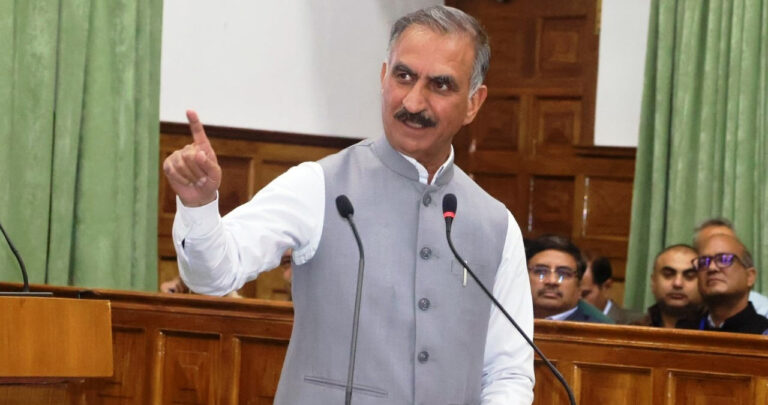
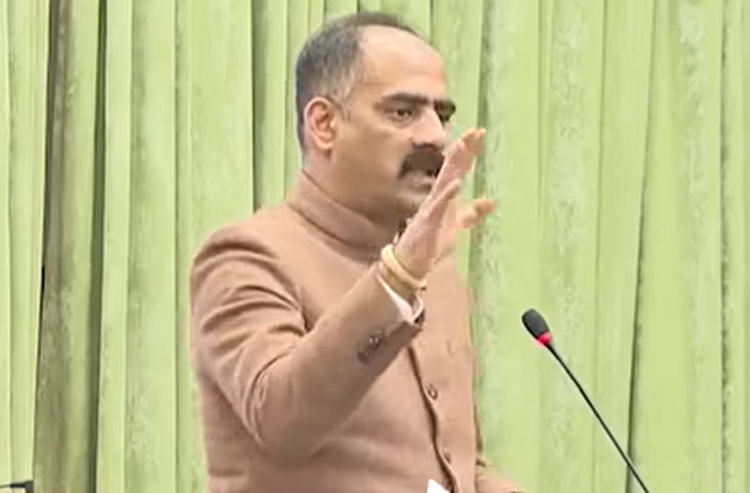
Shimla: Who really controls the process of granting permissions under Section 118 of the Himachal Pradesh Tenancy and Land Reforms Act, 1972? A startling remark by Rural Development and Panchayati Raj Minister Anirudh Singh in the Himachal Pradesh Vidhan Sabha has brought this question into sharp focus, exposing alleged deep-rooted corruption and the influence of middlemen in the state’s revenue administration.
Speaking in the Assembly, Singh alleged that touts are entrenched in the system from the Patwari level all the way up, facilitating permissions under Section 118. His remarks have raised serious questions about the transparency of the land permission process and the possible involvement of officials at different levels of the revenue machinery.
The minister’s statement is particularly significant as Section 118 is considered one of the most important legal safeguards protecting land ownership in Himachal Pradesh. The provision restricts the transfer of land to non-agriculturists, including individuals from outside the state, except with permission from the state government under prescribed conditions.
However, over the years, the law has repeatedly come under scrutiny amid allegations that its provisions are being circumvented through benami transactions, proxy ownership, questionable partnerships and manipulation of official records.
Section 118: A protective law allegedly turned into a route for land deals
The original objective of Section 118 was to prevent indiscriminate acquisition of agricultural land by non-agriculturists and protect the interests of local residents. However, allegations have persisted that influential investors and developers have found ways to bypass its restrictions.
One of the major concerns has been the alleged use of local agriculturists as proxy owners, with land purchased in their names while the actual financial investment and control remain with outsiders. Questions have also been raised over companies and partnership firms being used to facilitate land acquisitions and subsequent commercial development.
There have been allegations that permissions granted for specific purposes, including industrial, tourism and residential projects, are sometimes diverted towards activities different from those originally approved.
The latest statement by Anirudh Singh has added an administrative dimension to these concerns, suggesting that the alleged problem is not limited to individual land transactions but may also involve an entrenched network of intermediaries within the revenue system.
Judicial commission had investigated alleged benami transactions
The controversy surrounding Section 118 dates back several decades and has surfaced under successive governments.
In 2011, the then state government constituted a judicial commission headed by retired High Court judge Justice D.P. Sood to investigate alleged benami land transactions and violations of Section 118 between 2003 and March 31, 2011. The commission was also tasked with examining irregularities involving essentiality certificates under the Himachal Pradesh Apartment and Property Regulation Act, 2005.
Despite repeated political assurances and administrative interventions, allegations of misuse have continued to surface, indicating the challenges involved in enforcing the law effectively.
Chester Hills case brings Solan land deals under scanner
The Chester Hills housing project in Solan has emerged as a prominent recent example of the controversy surrounding Section 118.
Complaints alleged that a local agriculturist was being used as a front for non-Himachali developers to acquire land and undertake real estate activities. An inquiry reportedly raised questions about the landowner’s financial capacity and the actual control of the project.
The allegations triggered political controversy and scrutiny by the district administration, bringing the issue of proxy ownership and the possible misuse of Section 118 permissions back into public debate.
Solan has increasingly emerged as a focal point of concerns over large-scale commercial construction, apartment complexes and land transactions involving non-agriculturists.
High Court intervention puts government under pressure
The issue has now attracted serious judicial attention. The Himachal Pradesh High Court has taken a stern view of the manner in which Section 118 permissions have been granted over the years.
A division bench comprising Chief Justice Gurmeet Singh Sandhawalia and Justice Bipin Chandra Negi has restrained the state government from granting fresh permissions for land acquisition in Solan district without prior approval of the Court.
The Court has also sought comprehensive details of permissions granted across Himachal Pradesh over the past decade, including information about rejected applications, revenue and stamp duty collections, and environmental clearances.
Expressing concern over large-scale commercial construction in Solan, the Court observed that successive governments had undermined the stringent provisions of Section 118 through unchecked permissions, weakening the safeguards intended to regulate land transfers to non-agriculturists.
The bigger question: Who is accountable?
Anirudh Singh’s statement has brought the spotlight on a crucial aspect of the controversy: the role of the revenue administration in processing and facilitating land purchase permissions.
If middlemen are operating from the Patwari level upwards, as alleged by the minister, the government faces a larger challenge than simply making the application process online. It must identify those facilitating irregular transactions, investigate the possible involvement of officials and establish accountability at every level.
The government has maintained that it intends to make the Section 118 process more transparent and take action against violations. However, the effectiveness of these assurances will ultimately depend on whether the alleged middlemen network is dismantled and those found guilty are brought to justice.
For Himachal Pradesh, the issue is about more than land permissions and commercial investments. It concerns the protection of limited land resources, the interests of local communities and the credibility of a law designed to safeguard the state’s unique land ownership framework.
The question now is not merely how many Section 118 permissions have been granted, but whether the system meant to regulate them has itself become vulnerable to manipulation.