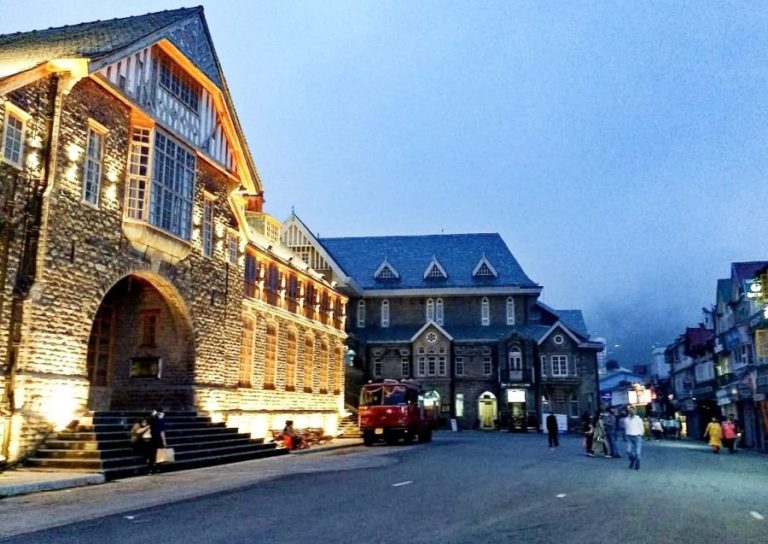

Shimla: Shimla, once known for its organised hill-town character and walkable streets, is increasingly struggling to manage its own roads, markets and public spaces. From the crowded lanes of Lower Bazaar, Ganj Bazaar and Lakkar Bazaar to Sanjauli, Kasumpti, Khalini and even the supposedly planned neighbourhoods of New Shimla, encroachments, roadside vending and illegal parking have become a growing urban challenge.
What should be public space for pedestrians and smooth traffic movement has increasingly turned into an extension of commercial establishments, makeshift vending stalls and unauthorised parking areas. Roads that were already narrow because of Shimla’s geographical constraints are being squeezed further, leaving commuters, pedestrians, shopkeepers and residents to negotiate their way through daily congestion.
The problem is no longer confined to traditional markets. It has spread across the city, exposing the limitations of urban planning, traffic regulation and enforcement by the Municipal Corporation and other concerned authorities. In Lower Bazaar, Ganj Bazaar and Lakkar Bazaar, pedestrians frequently struggle to find sufficient walking space as roadside merchandise and temporary stalls occupy valuable public areas. Similar complaints are emerging from Sanjauli and Kasumpti, while Khalini and New Shimla are also witnessing growing pressure from roadside vending and vehicles parked indiscriminately.
The situation raises a fundamental question: if even New Shimla, developed as a planned residential area, is facing the same problems, what has gone wrong with the city’s urban management?
The Shimla Municipal Corporation has recently intensified its action against street vendors occupying restricted areas. The corporation has been directing vendors operating in non-vending zones to shift to designated locations, particularly in the city’s congested commercial areas. According to recent reports, the Town Vending Committee has rejected more than 500 applications for street-vendor registration due to incomplete documentation, while 442 vendors have completed the registration process and received identity cards. The corporation has also warned of penalties and confiscation of goods in cases of repeated violations.
In its latest move, the corporation has directed vendors operating in Lower and Middle Bazaar to shift to designated spaces at Aajeevika Bhawan by November 15. The relocation drive has, however, triggered objections from vendors, who argue that the alternative location may not provide adequate customer access and could affect their livelihoods.
Aajeevika Bhawan: Has One Problem Been Shifted to Create Another?
While the rehabilitation of street vendors is a legitimate administrative responsibility, it cannot come at the cost of violating building regulations or compromising public infrastructure. The proposed vending arrangement at Aajeevika Bhawan has raised questions about the intended use of the building. If the space being allotted to vendors is designated as a parking floor in the approved building plan, its conversion into a vending area would require clear legal justification and compliance with applicable building regulations. The Municipal Corporation must make the sanctioned plan public and explain whether the proposed use is permissible. Shifting an encroachment from one location to another cannot be considered a permanent solution, particularly if it creates fresh questions about the use of public property.
The seriousness of Shimla’s encroachment problem has also figured in judicial proceedings. In an order dated August 19, 2026, the Himachal Pradesh High Court referred to severe congestion in Lower Bazaar and the difficulties faced by emergency services. Earlier proceedings had highlighted reports of ambulances struggling to pass through the market because of encroachments. The court also emphasised the need to maintain non-vending zones, remove unauthorised obstructions and ensure unobstructed movement for emergency vehicles.
However, street vending is only one part of Shimla’s growing encroachment problem. Illegal parking has emerged as an equally serious challenge. Vehicles parked along already narrow roads reduce the available carriageway, create bottlenecks and frequently bring traffic movement to a standstill. In several residential and commercial areas, roads that should facilitate smooth movement are increasingly being used as informal parking spaces. Residents of Sanjauli, Kasumpti, Khalini and New Shimla face daily traffic congestion despite these areas being important residential and commercial centres.
The administration cannot selectively enforce rules against street vendors while overlooking unauthorised parking, encroachments by established commercial establishments and the occupation of public spaces through other means. If a street vendor is removed for obstructing a pedestrian pathway, the same principle must apply to shopkeepers extending their merchandise onto public roads and vehicle owners occupying restricted spaces. Enforcement cannot be selective.
Shimla’s geographical limitations are well known. Unlike cities on the plains, the hill capital cannot keep widening its roads to accommodate every additional vehicle, commercial activity or roadside establishment. This makes the protection of existing public space even more important. The Municipal Corporation, Traffic Police and district administration must ensure that roads, footpaths, market passages and emergency access routes remain free from unauthorised occupation.
What Shimla needs is not another temporary eviction exercise followed by the return of the same problems after a few weeks. The city requires a comprehensive and permanent encroachment management policy, supported by clearly identified vending zones, adequate parking facilities and strict enforcement of traffic regulations. The legality of proposed vending spaces at Aajeevika Bhawan must also be established before rehabilitation is undertaken.
The larger question is one of accountability. How have encroachments been allowed to spread across the city despite repeated drives, court directions and public complaints? Why are roads in even the planned areas losing their intended character? And why does every enforcement exercise appear to address one location while leaving the larger problem unresolved?
Shimla cannot aspire to be a modern, planned and tourist-friendly city while its residents struggle every day to walk through markets, find parking or travel a few kilometres without getting trapped in traffic. Public roads and pedestrian spaces belong to the people, not to vendors, shopkeepers or vehicle owners who occupy them without authorisation.
A city does not become congested overnight. It reaches this condition when small violations are ignored, temporary arrangements become permanent and enforcement is reduced to occasional drives. Shimla needs more than eviction notices and temporary relocations. It needs accountability, consistent enforcement and a clear commitment to reclaiming its public spaces.