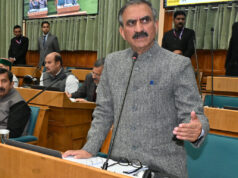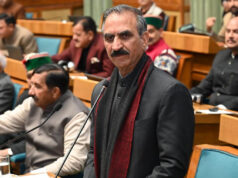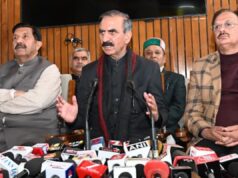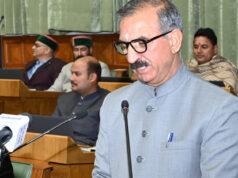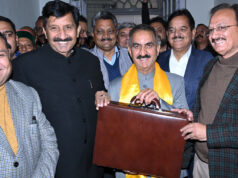


Shimla: Himachal Pradesh is grappling with mounting financial strain as Chief Minister Sukhvinder Singh Sukhu on Saturday presented a ₹54,928-crore budget for the financial year 2026-27 in the Vidhan Sabha, nearly ₹4,000 crore less than last year’s ₹58,514 crore.
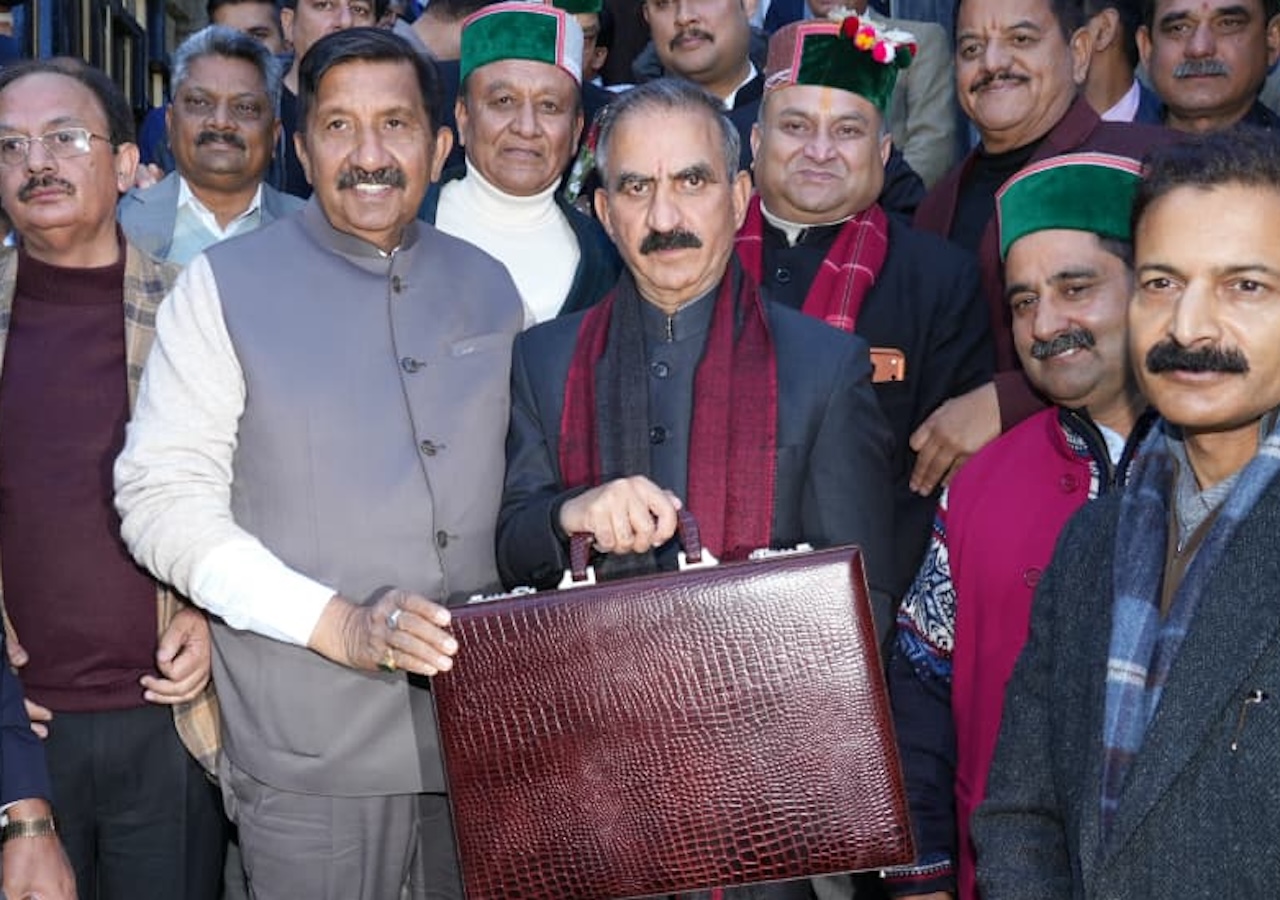
Presenting his fourth budget, Sukhu acknowledged the pressure on the state’s finances, primarily due to the discontinuation of the Revenue Deficit Grant (RDG) by the Centre. He stated that the withdrawal of RDG would result in an annual loss of ₹8,105 crore, significantly reducing the state’s fiscal capacity.
The budget estimates revenue receipts at ₹40,361 crore and total revenue expenditure at ₹46,938 crore, resulting in a revenue deficit of ₹6,577 crore. The fiscal deficit is projected at ₹9,698 crore, which is 3.49 per cent of the state’s Gross Domestic Product (GSDP), reflecting tight fiscal management amid limited resources.
Breaking down the expenditure, the Chief Minister said that out of every ₹100 spent, ₹27 will go towards salaries, ₹21 for pensions, ₹13 for interest payments, ₹9 for loan repayments, and ₹10 as grants to autonomous institutions. Only ₹20 will be available for other activities, including capital works, highlighting the constrained fiscal space.
Despite the financial challenges, the government has maintained allocations for key sectors. Sukhu said there would be no cuts in the rural economy, education, and health sectors, and budgets for departments like Jal Shakti and Public Works have also been retained. Stressing the need for fiscal discipline, he said the state must focus on optimal utilisation of its limited resources, adding that forests and water remain its primary assets. He also reiterated the demand for a ‘Green Bonus’ for hill states.
The budget speech saw interruptions from the Opposition, which raised slogans during the presentation. Responding to the criticism, Sukhu accused previous governments of abandoning the state during difficult times and termed the discontinuation of RDG as contrary to the spirit of support for hill states.
Among key announcements, ₹500 crore has been allocated to complete pending projects, while vacant government buildings will be put to productive use through private sector participation. In a push to the rural economy, support prices were announced for naturally grown crops, including ₹80 per kg for wheat, ₹50 per kg for maize, ₹80 per kg for barley from Pangi Valley, ₹150 per kg for turmeric, and ₹30 per kg for ginger. Milk procurement prices were fixed at ₹61 per litre for cow milk and ₹71 per litre for buffalo milk.
A State Farmers’ Commission will be set up, and ₹325 crore has been earmarked for the HP-SHIVA Project. The government has also proposed ₹10 crore under the Mukhyamantri Khet Badbandi Yojana and ₹62 crore for poultry farming.
In the fisheries sector, royalty on fish caught from reservoirs has been reduced to 1 per cent. Fishermen will receive ₹3,500 during the ban period, along with a 70 per cent subsidy on boats. An Integrated Aqua Park will be set up in Nadaun, and 100 new trout farming units will be established.
Tourism has been identified as a growth driver, with plans to promote religious tourism and “slow tourism” in rural areas. A Himachal Pradesh Women Tourism Fund will be created, and initiatives such as developing wedding destinations, introducing night picnicking, and promoting tourism around water bodies were announced. A film portal will also be set up.
On the social front, the government announced the ‘Apna Sukhi Parivar’ scheme for one lakh extremely poor families, including 300 units of free electricity and a monthly stipend of ₹1,500 for women. Gram Sabhas will be empowered to add new families to the BPL list.
Infrastructure projects include ₹2,000 crore for land acquisition for the Kangra Airport expansion, approval for 800 km of roads under PMGSY-4, and proposals for tunnels at Jalori Jot and Chamba. Work on the Mandi-Gagal-Chailchowk road is also expected to begin soon.
The budget also outlines recruitment plans, including 1,000 police constables, 50 women sub-inspectors, and 149 junior engineers. Measures to tackle drug trafficking, including anonymity for informants and the launch of the ‘Cyber Mitra’ scheme, were also announced.
In education, 150 more schools will be affiliated with CBSE, and a dedicated cadre will be created. The government also announced a ban on mobile phones in schools and plans to introduce a new industrial policy along with the ‘Him Startup’ scheme.
With rising deficits, reduced central support, and limited internal revenue generation, the budget reflects the tough fiscal situation of Himachal Pradesh. The coming financial year is expected to test the state’s ability to balance welfare commitments with fiscal discipline while navigating ongoing economic challenges.