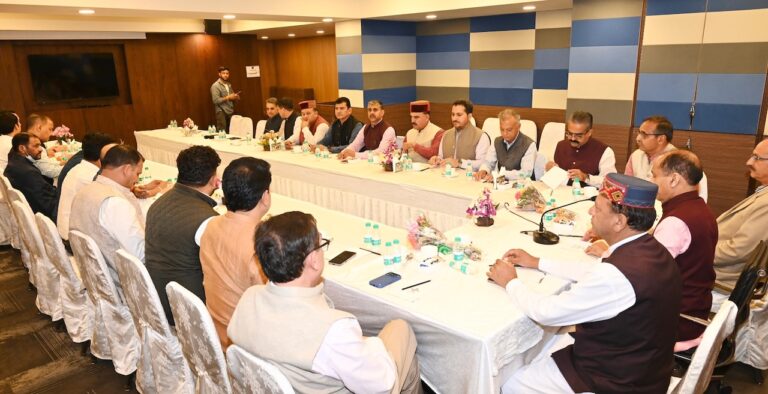
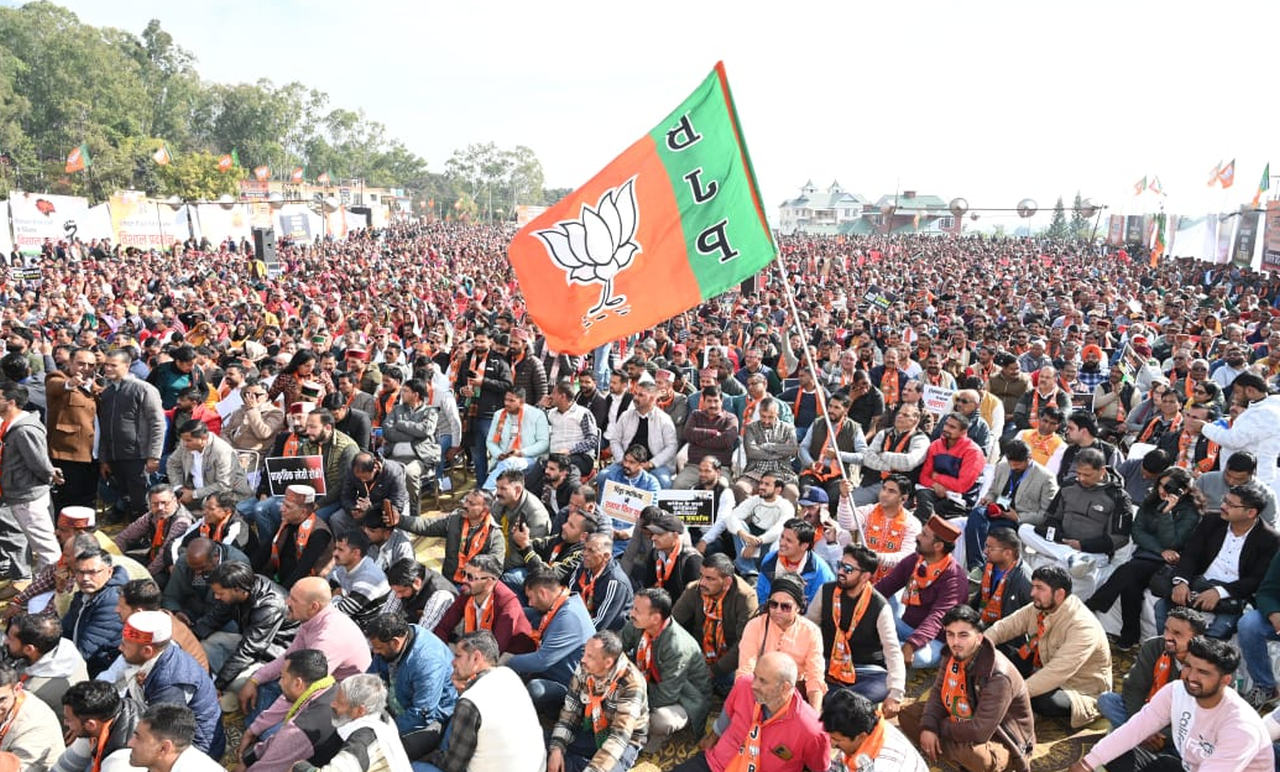
The Himachal Pradesh BJP has reduced the size of its core committee, but the political questions surrounding the party’s internal power structure have only grown bigger. What is being presented as an organisational exercise to streamline decision-making has also triggered a debate over leadership, representation, generational change and the influence of different political camps within the state unit.
The reduction of the committee from 21 to 12 regular members is not merely a numerical adjustment. It has changed the composition of the party’s most important state-level decision-making forum and brought its internal equations into sharper focus.
The most striking feature of the reshuffle is the absence of three prominent political figures: former Chief Ministers Prem Kumar Dhumal and Shanta Kumar, and Rajya Sabha MP Harsh Mahajan. Senior leader Randhir Sharma has also been left out. Their exclusion has raised questions about the place of political experience and established leadership in the BJP’s evolving organisational structure.
For a party that has historically drawn strength from leaders with strong regional and organisational networks, managing the transition between generations has never been a simple exercise.
The old guard and the new power equation
Prem Kumar Dhumal and Shanta Kumar are not ordinary names in Himachal BJP politics. Both have played defining roles in building and expanding the party’s political presence in the state. Their political influence extends beyond their formal positions, with generations of party workers having developed organisational and political associations with them.
Their absence from the new core committee may indicate a shift towards a different leadership arrangement. However, it also raises a fundamental question: can the party move towards a new organisational structure without adequately engaging the political legacy and networks of its senior leaders?
The BJP may have every reason to streamline its decision-making mechanism, but organisational efficiency and political inclusiveness are not necessarily competing objectives. A compact leadership group can take decisions more quickly, but a political organisation also needs wider consultation to maintain confidence among its cadres.
The exclusion of Harsh Mahajan presents another interesting dimension. Having crossed over from the Congress to the BJP, Mahajan became an important political figure during the 2024 Rajya Sabha election, when the BJP candidate defeated the Congress nominee despite the latter party’s Assembly majority.
His absence from the core committee raises questions about the organisational accommodation of leaders who enter the BJP from other political parties. Political entry and organisational acceptance are two different processes. The party’s ability to integrate such leaders into its established structure remains an important aspect of its internal politics.
Satti’s return and the importance of the old organisational network
The inclusion of former state BJP president Satpal Singh Satti is equally noteworthy. Satti represents the party’s established organisational tradition and has considerable experience in handling the state unit.
His presence can be viewed as an effort to retain experienced organisational leadership within the decision-making structure. The inclusion of Vipin Singh Parmar also brings legislative and administrative experience to the committee.
However, this raises a larger issue concerning the relationship between the BJP’s traditional cadre and leaders who have emerged through electoral politics or joined the party from other political backgrounds.
For any political organisation, the distribution of responsibilities is as important as the distribution of election tickets. When party workers perceive that organisational positions and political opportunities are concentrated within a limited circle, dissatisfaction can emerge at the grassroots level.
The BJP’s challenge will be to ensure that the restructuring does not create a perception of insiders and outsiders within its own ranks.
Nadda and Anurag strengthen the central connection
The presence of former BJP national president and Union Minister JP Nadda and former Union Minister Anurag Thakur gives the new committee a strong national political dimension.
Both leaders have considerable experience in national politics and organisational affairs. Their inclusion provides the Himachal BJP with access to senior leadership and strengthens the coordination between the state unit and the central organisation.
But their presence also brings another question into the discussion: how much space will the state leadership have in shaping the party’s political and organisational decisions?
Himachal Pradesh has its own political realities, regional considerations and constituency-level equations. Decisions taken at the national level must ultimately translate into an effective organisational structure at the local level.
The balance between central guidance and state-level consultation will therefore remain important. The BJP cannot afford to overlook the significance of local leadership networks while preparing its electoral strategy.
The factional question remains unresolved; 2027: The bigger challenge
The Himachal BJP has, for years, witnessed different leadership groups and political loyalties within its organisational structure. Supporters associated with Dhumal, Jai Ram Thakur, the central leadership and established organisational workers have their own political identities and networks.
These differences do not necessarily translate into open conflict, but they have often made leadership management a complicated exercise.
The new committee has changed the representation of these groups, but whether it has addressed the underlying differences remains an open question.
A smaller committee may reduce the number of people directly involved in high-level discussions. However, it cannot automatically eliminate differences over political responsibilities, organisational appointments or the selection of candidates.
In fact, the real test of the new arrangement will emerge when decisions have to be taken on issues where different political interests intersect.
With the next Himachal Pradesh Assembly elections scheduled for 2027, the BJP’s organisational restructuring must be viewed in the context of its preparations to challenge the Congress government.
The party will have to build a strong campaign, strengthen its booth-level organisation, identify constituency-level issues and develop a credible political narrative. At the same time, it will need to manage expectations among leaders and workers who aspire to play a greater role.
Ticket distribution could prove particularly challenging. Leaders who are currently outside the core committee may still have significant political influence in their respective constituencies. Their supporters and organisational networks cannot simply be overlooked.
The party will also have to ensure that experienced leaders remain engaged and that younger leadership gets adequate opportunities to grow. A successful electoral organisation requires both continuity and renewal.
For the BJP, therefore, the challenge is twofold: presenting a united political front against the Congress while maintaining internal coordination within its own organisation.
A smaller committee does not necessarily mean a stronger organisation
The reorganisation has certainly created a more compact decision-making structure. But the effectiveness of a political organisation cannot be measured simply by the number of members sitting around its decision-making table.
The real measure will be whether the new committee can accommodate different political interests, maintain communication with senior leaders, motivate grassroots workers and build consensus on important organisational decisions.
Dhumal, Shanta Kumar, Harsh Mahajan and Randhir Sharma may be outside the new core committee, but the political questions surrounding their exclusion will remain part of the larger discussion about the party’s leadership structure.
Likewise, the presence of Nadda, Anurag Thakur and other prominent leaders will bring expectations of stronger coordination and strategic direction.
The BJP has changed the size and composition of its inner circle. Whether this results in a more cohesive organisation or creates new questions about representation and influence will become clearer in the months ahead.
Ultimately, the BJP’s biggest challenge before 2027 may not be the size of its core committee, but the size of the political tent it is willing to accommodate. A smaller table can make decision-making easier, but keeping the entire organisation together will require considerably more political management.