
Shimla: While Diwali across the country is celebrated with the glow of earthen lamps, fireworks, sweets and family gatherings, a small village near Shimla observes the festival in a remarkably different way. Here, the day after Diwali is marked not merely by celebrations but by an age-old ritual in which stones are hurled at one another in the name of faith, tradition and history.
This is Dhami’s famous Pathar Mela, or stone-pelting festival, held at Halog, the former capital of the princely state of Dhami, around 25 kilometres from Shimla. Every year, the unusual gathering attracts villagers, devotees, curious visitors and people interested in Himachal Pradesh’s rich cultural traditions.
What makes this festival extraordinary is that stone-pelting, an act generally associated with conflict and violence, becomes a ritual expression of collective faith and cultural identity. Participants willingly take part in the traditional contest, keeping alive a practice that has been passed down through generations.
A ritual rooted in legend and sacrifice
The origins of the Pathar Mela are closely linked to local folklore surrounding the erstwhile Dhami princely state and its royal family. According to a widely recounted tradition, human sacrifice was once practised to appease the presiding deity and seek protection from calamities, disease and misfortune.
Local accounts attribute the transformation of this practice to a queen of Dhami, who is said to have sought an end to human sacrifice. According to the legend, the stone-pelting ritual emerged as an alternative, with the blood of an injured participant used for the ceremonial tilak of the goddess.
Although different versions of the story exist, the central belief remains the same among those who preserve the tradition: the ritual represents a departure from an older and more extreme form of sacrifice. Over the centuries, it has become an enduring part of the region’s cultural and religious identity.
The story is passed down through generations, connecting contemporary villagers with the memories, beliefs and traditions of the former princely state.
When two groups face each other
The most dramatic moment of the festival comes when the two traditional groups assemble for the ritual. Historically, the contest has involved residents associated with Halog and Jamog, although the names used for the participating groups vary across accounts.
The ceremony is preceded by religious observances, with the procession and traditional music helping establish the solemn atmosphere. The ritual then begins, and participants throw stones towards the opposing group according to the established custom. The contest continues until the traditional condition for its conclusion is met.
For spectators, the scene is both startling and fascinating. The sight of people voluntarily participating in stone-pelting stands in sharp contrast to the usual imagery of Diwali celebrations. Yet, for the local community, the event is not simply an unusual spectacle. It is a ritual whose meaning is rooted in inherited beliefs and collective memory.
The conclusion of the contest is marked by the use of blood from an injured participant to apply a tilak to the deity. This is the defining element of the tradition and the moment around which the ritual’s religious significance revolves.
Beyond the stones: A celebration of community
The significance of Dhami’s Pathar Mela extends beyond the stone-pelting itself. The gathering brings together people from Halog and neighbouring villages, including families who return to participate in or witness a tradition they have known since childhood.
Once the ritual concludes, the atmosphere changes. Religious observances give way to celebrations, with traditional music, dancing and social gatherings marking the occasion. The transition from an intense ritual to a shared celebration reflects the festival’s broader social character.
Like many traditional fairs in Himachal Pradesh, the event creates an opportunity for people to reconnect with their roots. It brings generations together, reinforces local relationships and gives younger residents an opportunity to learn about the customs and stories that have shaped their community.
In an age when changing lifestyles and urbanisation are transforming village life, such gatherings also serve as living repositories of local heritage.
Tradition in a changing world
The Pathar Mela also raises important questions about how communities preserve ancient customs while responding to contemporary concerns about safety and human welfare.
Although participants regard the ritual as an expression of faith, stone-pelting carries a genuine risk of injury. The use of human blood as part of the ceremony has also drawn attention to the need to balance cultural continuity with the protection of participants. Reports from previous editions have documented injuries during the event.
Preserving a tradition does not necessarily mean that every aspect of it must remain unchanged. Community dialogue, appropriate safety arrangements and respect for local beliefs can all contribute to discussions about how such practices might continue responsibly.
For Dhami, the challenge is to safeguard the historical and cultural significance of the fair while ensuring that its celebration does not come at the cost of participants’ well-being.
An unusual chapter in Himachal’s cultural heritage
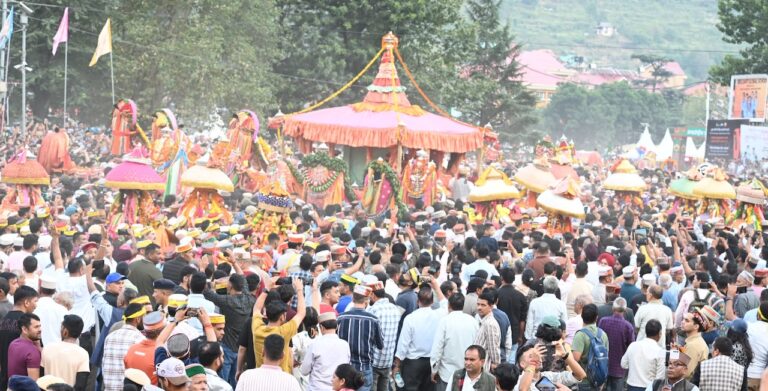
Himachal Pradesh is known for its diverse dev traditions, village fairs, seasonal festivals and distinctive rituals. From processions honouring local deities to folk dances and community gatherings, these practices reflect the close relationship between religion, geography and everyday life in the hills.
Dhami’s Pathar Mela occupies a particularly unusual place in this cultural landscape. It is a tradition shaped by a combination of royal history, local folklore, religious belief and community participation.
Its identity rests on a striking paradox: an act ordinarily associated with violence has acquired ritual significance within a particular historical and cultural setting. Understanding the festival therefore requires looking beyond the stones to the stories, beliefs and social relationships that sustain it.
As another Diwali season brings people to Halog, the Pathar Mela remains a reminder that India’s cultural traditions are far from uniform. Some are celebrated with lamps and prayers, others with music and dance, and some through rituals that challenge outsiders’ expectations.
For the people of Dhami, the festival is more than a spectacle. It is a link with the past, a marker of collective identity and a tradition whose future will depend on how heritage and changing social values are brought together.