
Nauni: Dr YS Parmar University of Horticulture and Forestry (UHF), Nauni, has called for greater public participation and changes in everyday lifestyles to reduce environmental damage and strengthen efforts to protect the ozone layer.
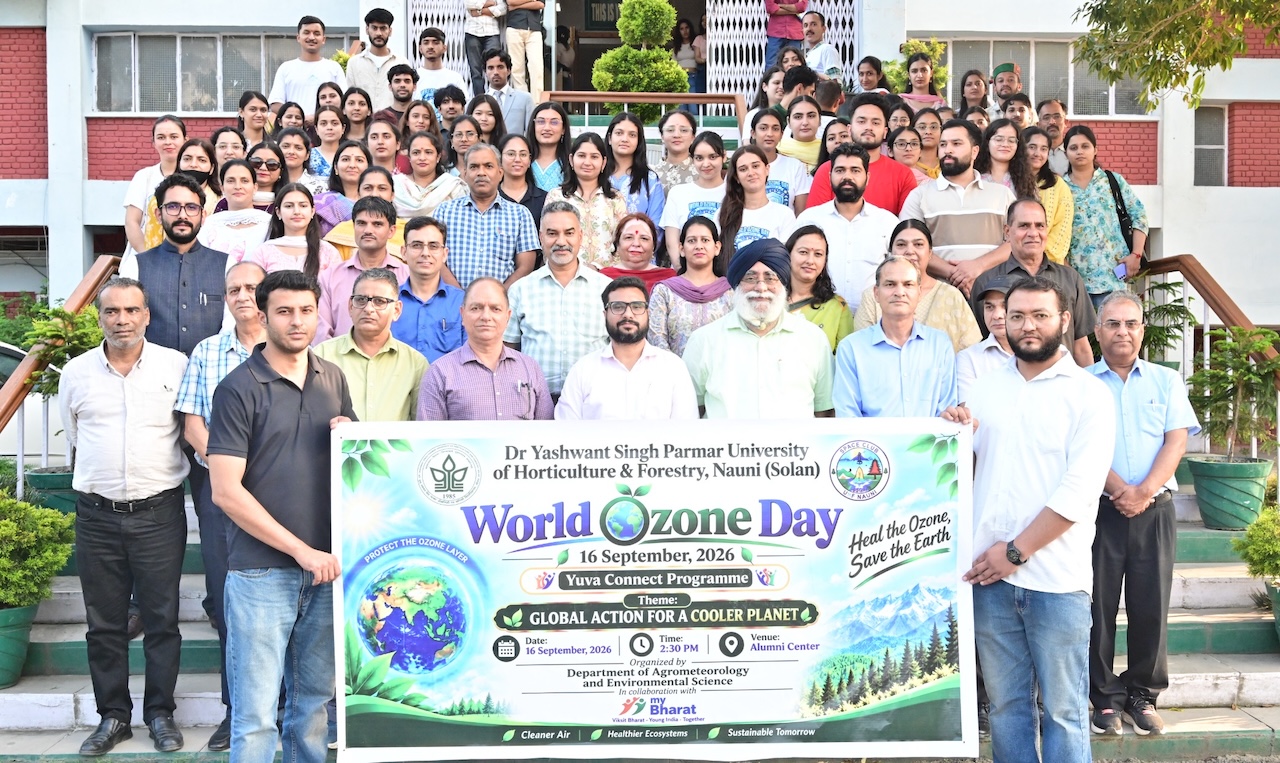
The message was highlighted during a World Ozone Day programme organised by the SPACE Club of the Department of Agrometeorology and Environmental Science in collaboration with the MY Bharat Programme, Ministry of Youth Affairs and Sports, Government of India.
Held on the theme ‘Global Action for a Cooler Planet’, the programme focused on creating awareness among students about ozone layer protection, environmental conservation and the impact of individual choices on the planet.
Prof. HS Baweja, Vice Chancellor, UHF, said environmental protection could not be the responsibility of governments and institutions alone and required active participation from every individual. He urged students to adopt environmentally responsible lifestyles and become ambassadors of environmental awareness in their communities.
Emphasising the need to balance development with conservation, Prof. Baweja said economic and technological progress must go hand in hand with responsible environmental practices. He also highlighted the role of scientific research, innovation and education in addressing emerging environmental challenges.
He said universities have an important responsibility to create environmental awareness among young people while developing practical solutions through research and innovation. Students, he added, should understand the connection between their everyday choices and their long-term impact on the environment.
Dr CL Thakur, Dean, College of Forestry, also stressed that lifestyle changes could play an important role in reducing individual environmental footprints. He said small changes in daily habits, when adopted collectively, could make a significant contribution to environmental conservation.
He encouraged students to take sustainable practices beyond the university campus and promote environmentally responsible habits in their homes and communities.
Earlier, Dr PK Baweja, Head, Department of Agrometeorology and Environmental Science, highlighted the significance of World Ozone Day and the role of the Montreal Protocol in global efforts to protect the ozone layer. She also spoke about the 10th anniversary of the Kigali Amendment, which seeks to phase down hydrofluorocarbons (HFCs) and contribute to efforts to address climate change.
Drawing attention to the vulnerability of Himalayan ecosystems, Dr Kumar Ambrish, Additional Director, Botanical Survey of India, highlighted the potential impact of ozone depletion and related environmental changes on alpine ecosystems. He said alpine flora, including several medicinal plant species, could be particularly vulnerable to changing environmental conditions.