

Despite the bursting of firecrackers across Himachal Pradesh, the air remained remarkably clean this Diwali, with only the industrial town of Baddi witnessing a moderate rise in pollution. According to the Himachal Pradesh State Pollution Control Board (HPSPCB), none of the 12 monitored locations in the state recorded “Poor” or “Severe” air quality. In contrast to metropolitan cities like Delhi, Mumbai, and Lucknow—where air quality dipped to “Very Poor” or “Severe” categories—Himachal Pradesh largely stayed in the “Good” to “Satisfactory” range.
As per the Board’s latest report, “Ambient Air Quality Monitoring during Diwali 2025,” the Air Quality Index (AQI) in Baddi touched 167 on Diwali day, significantly lower than last year’s 392. This year’s readings show a remarkable improvement, reflecting reduced industrial activity and greater public awareness about environmental protection. In fact, Baddi’s AQI was even lower than what it reached earlier this month, when levels had peaked at 183 on October 16.
Shimla, Manali, and Sundernagar recorded the cleanest air during the festival, with AQI levels below 50, categorised as “Good.” Shimla’s AQI stood at 46 on Diwali—slightly higher than its pre-Diwali reading of 33—but still far from any health concern. Manali recorded an AQI of 62, while Sundernagar remained below 70. These readings show that the hill towns continue to maintain excellent air quality, despite festive celebrations.
In Dharamshala, the AQI rose from 62 to 120, placing it in the “Moderate” category. Una registered 140, while Paonta Sahib and Damtal recorded 123 and 97, respectively. The report also noted that Parwanoo, Barotiwala, and Nalagarh—key industrial towns—remained well within “Satisfactory” limits, a significant improvement over last year.
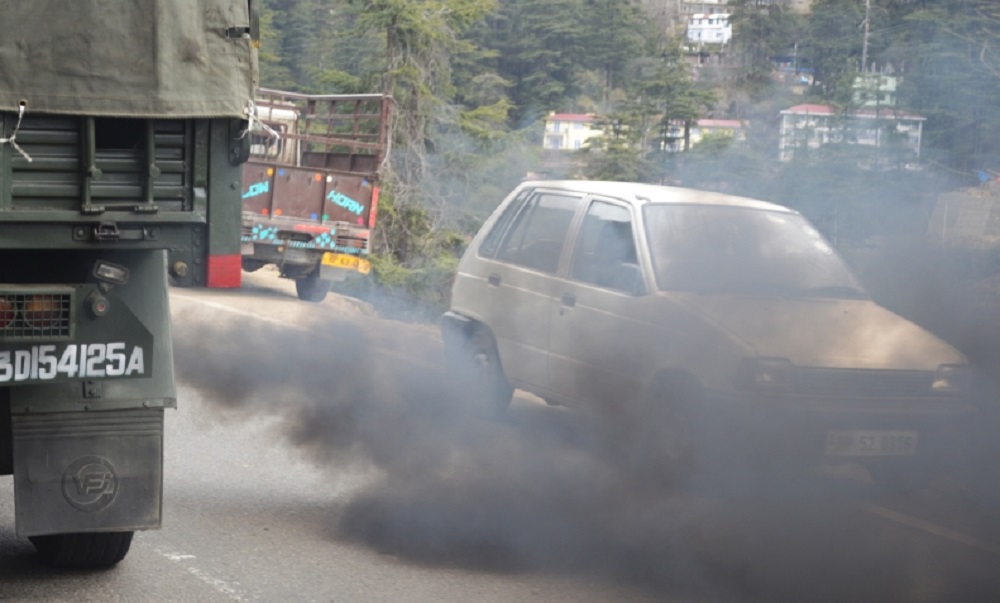
A Pollution Board official said, Air pollution levels were noticeably lower this year because several industries remained closed during Diwali. Public cooperation and awareness about the ill effects of pollution also played a vital role, and further added that reduced traffic contributed to lower pollution levels. “Vehicle movement on the Baddi-Sai road was lighter than usual this year, leading to better air quality,” he added.
However, while the air remained cleaner, noise pollution surged across several towns during the festivities. Monitoring conducted between 6 p.m. and midnight on Diwali revealed that noise levels exceeded permissible limits in Chamba, Una, Rampur Bushahr, Kinnaur, Baddi, and Kullu.
The highest spike was recorded in Chamba’s residential area, where decibel levels rose from 56.8 to 78.1—far above the standard residential limit of 55 decibels. Una’s Rakkad Colony also saw a sharp jump from 43.7 to 73.9 decibels, while Rampur Bushahr’s commercial area touched 77.3 decibels. In contrast, Shimla’s Ridge area recorded a minimal increase, from 64.4 to 64.9 decibels.
While major cities like Delhi, Mumbai, and Kolkata continue to struggle with toxic post-Diwali smog, Himachal Pradesh’s data paints a different picture—one of growing environmental consciousness and effective regulation. The hill state’s relatively clean air this Diwali offers a hopeful model for other parts of the country battling worsening pollution levels.