Imagine stepping out of a train at a railway station perched nearly 17,600 feet above sea level, surrounded by towering Himalayan peaks, snow-covered mountain passes and some of the world’s most challenging terrain. At this altitude, even breathing becomes an effort, temperatures can plunge dramatically, and the landscape appears almost otherworldly.
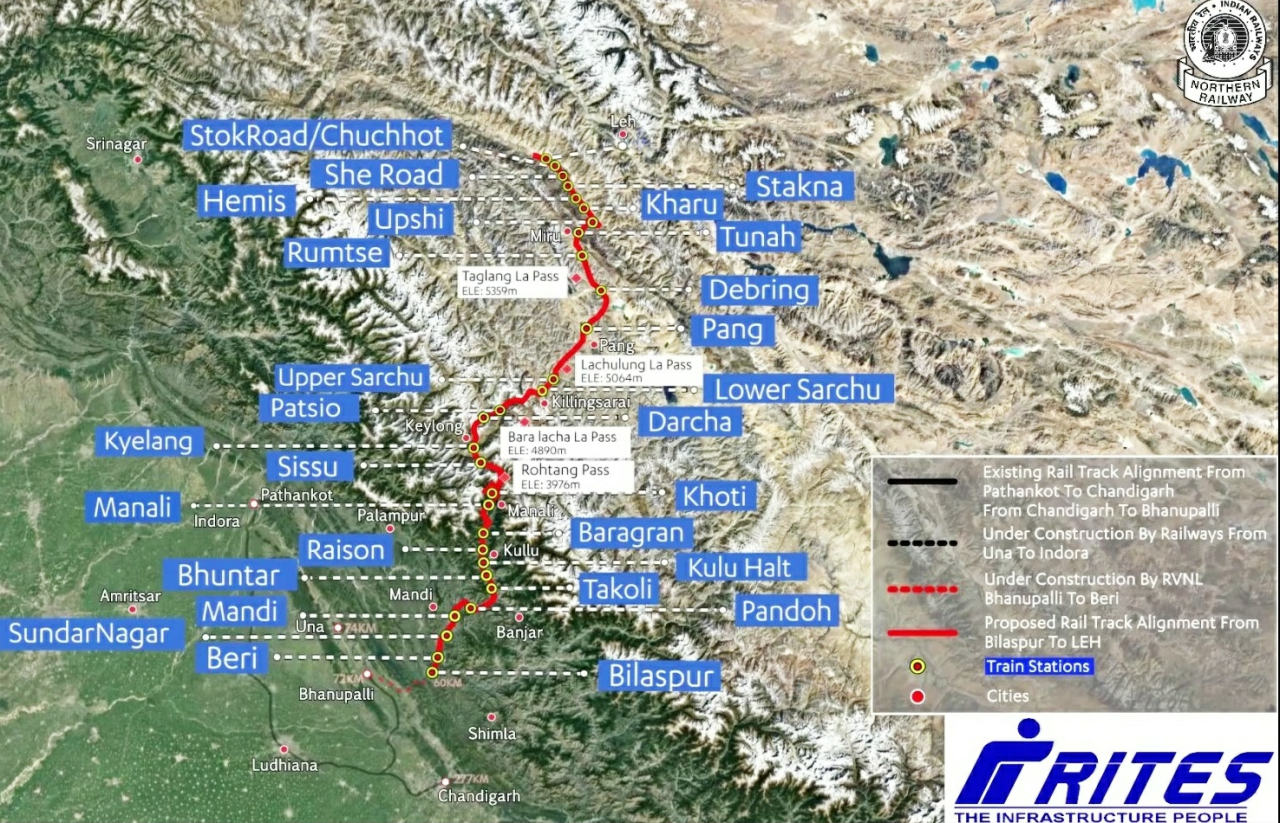
This could one day become a reality in India. The proposed Bilaspur-Manali-Leh railway line, one of the most ambitious railway infrastructure projects envisioned in the Himalayas, could feature the world’s highest railway station at Tengla in Ladakh, near the Tanglang La mountain pass.
At an estimated altitude of 17,582 feet (5,359 metres), the proposed Tengla station could surpass China’s Tanggula railway station in Tibet, which stands at approximately 16,627 feet (5,068 metres) and is widely recognised as the world’s highest railway station. If realised as proposed, the Indian station would rewrite the record books and place the country at the forefront of high-altitude railway engineering.
But the significance of this railway line goes far beyond a world record. It represents an extraordinary engineering ambition: taking the railway network through some of the most inaccessible, geographically challenging and strategically sensitive regions of the Indian Himalayas.
A 489-Km Journey Through the Heart of the Himalayas
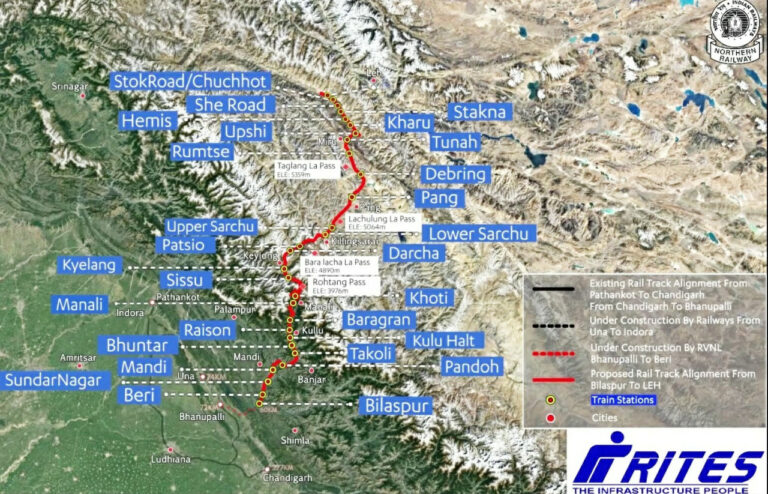
The proposed railway corridor will stretch approximately 489 kilometres, connecting Beri/Bilaspur in Himachal Pradesh with Leh in Ladakh. It will pass through some of the most spectacular yet geographically challenging terrain of the Himalayas.
The proposed alignment includes Sundernagar, Mandi, Manali, Sissu, Darcha, Keylong, Sarchu, Pang, Rumtse, Upshi and Kharu before terminating at Leh. For residents of these remote mountain settlements, the railway could transform access to education, healthcare, markets and employment opportunities.
For travellers, it could offer an entirely new way of experiencing the Himalayan landscape. Instead of navigating winding mountain roads and high-altitude passes, passengers could travel through an extraordinary network of tunnels, bridges and mountain stations.
The railway is planned as a 1,676-mm broad-gauge line, bringing the remote Himalayan region into the country’s conventional railway network.
270 Km of Tunnels: A Railway Beneath the Mountains
Perhaps the most astonishing feature of the project is that more than half of its total length will pass underground.
According to the Detailed Project Report (DPR), the 489-km railway corridor will require approximately 270 kilometres of tunnels. The project envisages 62 tunnels, making it one of the most tunnel-intensive railway projects ever planned in India.
In addition, the proposed infrastructure includes 114 major bridges, 90 minor bridges and two important bridges. The engineering design also provides for electric traction, electronic interlocking signalling and ballastless track technology.
These figures offer a glimpse of the extraordinary engineering challenges involved. Engineers will have to negotiate unstable geological formations, deep valleys, extreme temperatures, snowbound terrain and unpredictable Himalayan weather.
The extensive tunnelling is not merely intended to shorten the route. It is also essential to avoid dangerous gradients, protect railway operations from extreme weather and establish a dependable transport corridor through difficult mountain terrain.
More Than Tourism: A Strategic Railway for National Security
The Ministry of Defence has identified the Bilaspur-Manali-Leh railway as a strategic railway project. Ladakh shares sensitive borders with China and Pakistan, making dependable transportation infrastructure particularly important for national security.
At present, road connectivity to Ladakh faces considerable seasonal challenges. Heavy snowfall and extreme weather frequently disrupt important mountain routes, including the Manali-Leh highway, affecting the movement of people, essential supplies and equipment.
An operational railway could provide a more reliable transportation alternative, facilitating the movement of military personnel, equipment, food supplies, fuel and other essential materials.
It could also reduce dependence on long and weather-sensitive road journeys, strengthening logistical preparedness in the strategically important region.
The project, therefore, is not simply about connecting two geographically distant destinations. It is also about strengthening India’s infrastructure in a sensitive border region.
A Lifeline for Himachal’s Remote Mountain Economy
For Himachal Pradesh, the railway could bring economic opportunities far beyond the major towns along its alignment.
Regions such as Lahaul-Spiti, Keylong, Sissu and adjoining areas remain geographically isolated, particularly during harsh winters. Improved railway connectivity could make transportation of agricultural produce, local products and essential commodities considerably easier.
It could also create opportunities for local entrepreneurs, hotels, homestays, restaurants, transport operators and tourism-related businesses.
Manali, already one of India’s most popular tourist destinations, could emerge as an important railway gateway to the high-altitude landscapes of Lahaul and Ladakh.
The railway could also encourage a new form of Himalayan tourism, attracting domestic and international travellers interested in mountain terrain, engineering marvels and high-altitude railway journeys.
For local communities, the biggest benefit may not necessarily be the arrival of tourists but the availability of dependable transportation throughout the year.
The ₹1.31 Lakh Crore Question: When Will the Dream Become Reality?
Despite its enormous potential, the Bilaspur-Manali-Leh railway remains a proposed project, and its construction has not yet received final approval.
According to the Ministry of Railways’ latest available official information, the Final Location Survey has been completed and the Detailed Project Report prepared. The estimated project cost has increased to approximately ₹1.31 lakh crore.
The government has also acknowledged that the challenging Himalayan geology, topography, clearances and consultations with various stakeholders, including the Ministry of Defence and Ministry of Finance, will be important in taking the project forward. No definitive construction commencement or completion date has been announced.
The scale of investment itself reflects the extraordinary complexity of constructing a railway through some of the world’s most difficult mountain terrain.
From an Engineering Dream to a Himalayan Reality
The Bilaspur-Manali-Leh railway represents an ambition that goes beyond conventional infrastructure development. It combines engineering innovation, national security, regional development and the possibility of creating a new global railway landmark.
If realised, the project could bring the remote Himalayan settlements of Himachal Pradesh and Ladakh closer to the national railway network, while opening new opportunities for tourism and economic development.
And perhaps one day, passengers travelling from Bilaspur towards Leh will look out of their train windows at the towering mountains, pass through kilometres of underground tunnels and finally arrive at Tengla, a station that could stand higher than any other railway station in the world.
For India, it would be more than a railway record. It would be a remarkable demonstration of how far engineering ambition can travel, even in the most formidable landscapes on Earth.