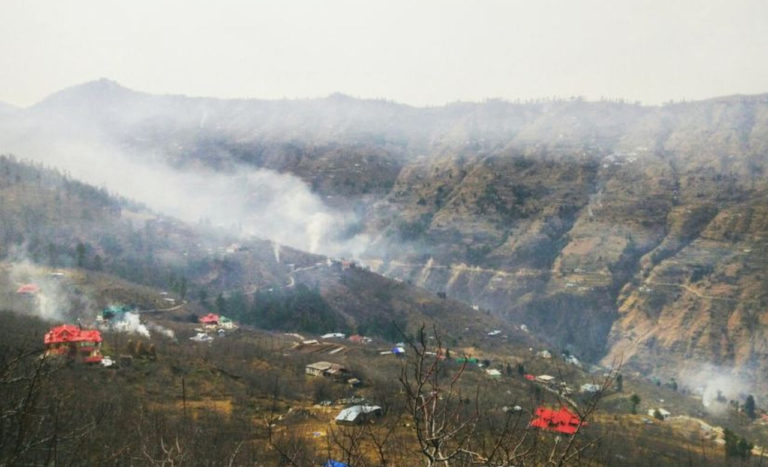

New Delhi/Shimla: The arrival of November has once again brought a familiar but alarming environmental crisis to northern India. Thick layers of smog have enveloped Delhi and several cities in Punjab and Haryana, while Lahore and other parts of Pakistan’s Punjab province are also struggling with deteriorating air quality. Adding to the regional concern, industrial towns in Himachal Pradesh, particularly Baddi, are witnessing a worrying rise in pollution levels, challenging the perception that the hill state is relatively insulated from the air-quality crisis affecting the northern plains.
The crisis is being driven by multiple factors, including agricultural residue burning, Diwali firecracker emissions, vehicular exhaust, industrial pollution, construction dust and unfavourable meteorological conditions. The combined effect has pushed several urban and industrial centres into unhealthy air-quality categories.
What makes the situation particularly concerning is that pollution is no longer an isolated problem affecting Delhi or a few industrial cities. It has become a regional environmental challenge involving the entire northwestern plains and neighbouring areas across the international border.
For millions of residents, the consequences are increasingly visible in everyday life: hazy skies, reduced visibility, irritation in the eyes and throat, breathing difficulties and growing concerns over long-term health consequences.
Delhi becomes the epicentre of the pollution emergency
The national capital has once again emerged as the centre of the regional air pollution crisis. Following Diwali celebrations, Delhi witnessed a sharp deterioration in air quality, with the CPCB recording an average Air Quality Index (AQI) of 376 on November 9, placing it in the ‘very poor’ category.
Several areas experienced even worse conditions, with independent monitoring platforms reporting exceptionally high readings. The combination of firecracker emissions, agricultural smoke, vehicular pollution and industrial activities contributed to the deterioration.
According to reports published on November 10, Delhi experienced its worst Diwali air quality in five years. The situation was further aggravated by low wind speeds, falling temperatures and stagnant atmospheric conditions, which prevented pollutants from dispersing.
The Commission for Air Quality Management (CAQM) has also invoked Stage III of the Graded Response Action Plan (GRAP) across the entire National Capital Region, effective November 6, in response to deteriorating air quality.
The crisis is not limited to Delhi. Several cities across Punjab and Haryana have also recorded alarming pollution levels, indicating that the problem has spread across a much wider geographical area.
Punjab and Haryana: Agricultural fields continue to burn
One of the major seasonal contributors to northern India’s pollution is the burning of paddy stubble in Punjab and Haryana.
Every year, following the paddy harvesting season, farmers face the challenge of clearing agricultural residue within a limited period to prepare their fields for wheat sowing. With limited time, labour shortages and the high cost of residue management, some farmers resort to burning the remaining straw.
The practice releases smoke, fine particulate matter and other harmful pollutants into the atmosphere. PM2.5 and PM10 particles can remain suspended in the air and travel considerable distances depending on prevailing wind conditions.
According to the Commission for Air Quality Management, Punjab recorded 4,459 stubble-burning incidents between September 15 and November 8, 2026.
However, an independent satellite-based assessment by aerosol remote-sensing scientist Dr Hiren Jethva estimated approximately 34,000 farm fires across Punjab and Haryana between October 1 and November 9.
The substantial difference between official figures and independent estimates has raised questions about the effectiveness of existing monitoring mechanisms. One possible explanation is that some farmers are increasingly burning crop residue during late afternoon and evening hours, when certain satellite monitoring systems may not detect every incident.
The district-wise figures from Punjab also reveal the concentration of farm fires in several agricultural districts. Tarn Taran, Ferozepur, Sangrur, Bathinda and Patiala have emerged among the affected areas.
The development has once again brought agricultural residue management into the spotlight, particularly the need to provide farmers with affordable alternatives to burning.
Pakistan’s Punjab also engulfed in smog
The pollution emergency has extended beyond India’s international border, with Lahore and other cities in Pakistan’s Punjab province experiencing severe smog.
Lahore’s AQI crossed the hazardous 500 mark on the morning of November 9, according to reported readings. The deterioration was attributed to a combination of agricultural residue burning, Diwali fireworks, easterly winds and stagnant atmospheric conditions.
The geographical proximity of agricultural fire hotspots in Indian Punjab to Pakistan’s Punjab province has added another dimension to the crisis. Amritsar is approximately 50 kilometres from Lahore, and changing wind patterns can facilitate the movement of smoke and particulate matter across the international boundary.
However, the pollution problem in Pakistan is not exclusively linked to smoke originating in India. Agricultural burning within Pakistan, industrial emissions, transport pollution, brick kilns and other local sources also contribute significantly.
The developments highlight the need for regional cooperation between India and Pakistan, particularly in sharing satellite observations, meteorological information and pollution-monitoring data.
Air pollution is an environmental challenge that cannot be addressed effectively through isolated action by individual states or countries.
Himachal Pradesh: The pollution crisis reaches the Himalayan foothills
While Delhi, Punjab and Haryana are witnessing some of the worst effects of the seasonal pollution crisis, Himachal Pradesh is also facing growing concerns over deteriorating air quality, particularly in its industrial belt.
The state’s mountainous geography often gives the impression that its air remains relatively clean compared with the densely populated northern plains. However, industrial emissions, vehicular pollution, construction dust and unfavourable local weather conditions are creating significant air-quality challenges in several towns.
The industrial hub of Baddi in Solan district has emerged as a major concern. According to recent reports, the town recorded an AQI of 193 on November 2, placing it in the moderate category but close to the poor category. The reading subsequently crossed 200, with an AQI of 211 reported on November 4.
A November 10 report by The Tribune highlighted further fluctuations in Baddi’s air quality. The AQI had declined from 224 before Diwali to 104 on the festival day, but subsequently climbed to 208 as industrial operations resumed and vehicular emissions increased.
The report also raised concerns over unusually high PM2.5 and PM10 concentrations and questioned the consistency of pollution-monitoring data.
Residents have raised concerns over industrial emissions, road dust, heavy vehicle movement and inadequate enforcement of pollution-control regulations. Industrial pockets such as Barotiwala and Jharmajri have also attracted attention because of their concentration of manufacturing units.
The problem is not confined to Baddi. Other industrial and urban centres, including Nalagarh, Parwanoo, Kala Amb, Paonta Sahib and Una, also require continuous monitoring.
A 2026 report prepared for the Himachal Pradesh government on non-CO2 emissions identifies seven towns—Baddi, Damtal, Kala Amb, Nalagarh, Paonta Sahib, Parwanoo and Sundernagar—as non-attainment cities under the National Clean Air Programme. These locations require sustained efforts to bring particulate pollution within prescribed standards.
The deterioration in Himachal’s air quality raises an important question: can a state known for its forests, mountains and relatively cleaner environment afford to ignore the growing pollution burden in its industrial and urban centres?
The answer is particularly significant because the Himalayan environment is ecologically sensitive. Air pollution can affect public health, vegetation and ecosystems, while certain short-lived climate pollutants, including black carbon, can contribute to the warming of snow and ice surfaces.
Although pollution transported from the plains may influence foothill areas under certain wind conditions, the contribution of outside sources must be established through atmospheric monitoring and scientific assessment rather than assumption.
Why November turns into a pollution emergency
The worsening air quality during November is not simply the result of increased emissions. Seasonal meteorological conditions play an equally important role in determining the severity and duration of pollution episodes.
During the transition from autumn to winter, temperatures begin to decline across northern India. Wind speeds frequently become weaker, while atmospheric stability increases.
One of the most important phenomena associated with winter pollution is temperature inversion.
Under normal atmospheric conditions, warmer air near the surface rises and helps disperse pollutants. During an inversion, a layer of warmer air settles above cooler air near the ground, restricting vertical movement and trapping pollutants close to the surface.
When this happens alongside low wind speeds, smoke from agricultural fires, vehicle exhaust, industrial emissions and construction dust accumulates, creating a thick layer of smog.
The Indo-Gangetic Plain is particularly vulnerable because of its geographical characteristics, high population density and concentration of agricultural, industrial and urban activities.
The Himalayan foothills also experience local variations in wind and temperature. Valleys and enclosed urban areas may experience pollution accumulation when atmospheric circulation is weak.
Not just stubble burning: Multiple sources are choking northern India
While agricultural fires receive considerable attention during November, treating stubble burning as the sole cause of the pollution crisis would be an incomplete assessment.
Delhi, Punjab, Haryana and Himachal Pradesh have multiple sources of pollution that operate throughout the year.
- Vehicular emissions: The increasing number of private vehicles, commercial transport vehicles and diesel-powered engines contributes significantly to urban air pollution.
- Industrial emissions: Factories, power generation units and manufacturing establishments release particulate matter and gaseous pollutants.
- Construction and road dust: Uncovered construction materials, poorly maintained roads and heavy traffic generate dust that contributes to PM10 pollution.
- Firecrackers: Fireworks release fine particles and chemical pollutants, adding to the existing pollution burden during Diwali.
- Waste burning: Open burning of garbage, leaves and other materials releases harmful smoke.
- Household fuel consumption: The use of solid fuels for cooking and heating in some areas adds to the regional pollution burden.
In Himachal Pradesh, the industrial belt of Baddi-Barotiwala-Nalagarh requires particular attention, while vehicle emissions and construction-related dust remain important concerns in growing urban centres.
The recurring pollution crisis therefore demands a comprehensive strategy that addresses emissions throughout the year rather than focusing exclusively on agricultural residue burning.
A public health emergency unfolding silently
The most serious consequence of deteriorating air quality is its impact on human health.
Fine particulate matter, particularly PM2.5, is small enough to penetrate deep into the lungs and enter the bloodstream. Prolonged exposure can increase the risk of respiratory and cardiovascular diseases.
Children, elderly people, pregnant women and individuals suffering from asthma, heart disease and other respiratory conditions are particularly vulnerable.
The immediate consequences include breathing difficulties, persistent coughing, throat irritation, burning eyes and worsening asthma symptoms.
Long-term exposure is associated with reduced lung function, chronic respiratory illnesses, cardiovascular complications and premature mortality.
For residents of Delhi, Punjab and Haryana, the winter pollution season has increasingly become a period of health-related uncertainty. In Himachal Pradesh, the growing pollution burden in industrial towns raises similar concerns, particularly among workers and residents living close to manufacturing establishments and busy roads.
Why Himachal needs a separate and stronger clean-air strategy
Himachal Pradesh needs to approach the pollution challenge with a strategy that recognises its distinctive geographical and environmental conditions.
The state’s industrial centres require stricter emission monitoring, while urban areas need improved public transport, dust management and effective regulation of construction activities.
The following measures deserve priority:
- Industrial emission monitoring: Strengthen inspections of industrial units and ensure that pollution-control equipment operates effectively.
- Improved monitoring infrastructure: Expand continuous air-quality monitoring stations, particularly in Baddi, Barotiwala, Nalagarh and other industrial pockets.
- Control of road dust: Improve road maintenance, mechanised cleaning and dust suppression, especially along heavily trafficked industrial routes.
- Cleaner transportation: Encourage public transport, electric mobility and stricter vehicle-emission checks.
- Protection of Himalayan ecosystems: Monitor pollutants that can affect forests, vegetation, snow and glaciers.
- Public health preparedness: Ensure timely air-quality advisories and better healthcare facilities for people exposed to industrial and urban pollution.
The state must also coordinate with neighbouring Punjab, Haryana and other northern states to improve regional air-quality monitoring and understand the movement of pollutants across geographical boundaries.
A regional crisis that demands coordinated action
The pollution emergency unfolding across Delhi, Punjab, Haryana, Himachal Pradesh and Pakistan’s Punjab province demonstrates that environmental degradation is no longer confined to individual cities or administrative boundaries.
Agricultural fires, industrial emissions, urban pollution and unfavourable winter weather conditions are combining to create an increasingly dangerous environment.
The difference between official farm-fire figures and independent satellite estimates has also exposed the need for more reliable monitoring and transparent environmental data.
More importantly, the crisis highlights the limitations of seasonal enforcement measures. Farmers need affordable alternatives to stubble burning, industries must comply with emission standards, and urban administrations must address vehicular and dust pollution.
For Himachal Pradesh, the warning is particularly important. A state whose economy and identity are closely connected with its natural environment cannot afford to allow its industrial and urban centres to become persistent pollution hotspots.
The burning fields of Punjab and Haryana, the choking streets of Delhi and Lahore, and the deteriorating air quality of Himachal’s industrial towns are different manifestations of the same regional environmental challenge. Unless governments move beyond seasonal firefighting and adopt sustained, science-based pollution-control measures, the winter smog will continue to return, threatening the health of millions and the ecological future of the northern region.