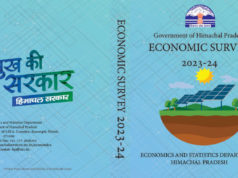


Shimla – Himachal Pradesh Chief Minister Sukhvinder Singh Sukhu on Friday tabled the Economic Survey 2025–26 in the Himachal Pradesh Legislative Assembly, presenting a picture of steady economic growth accompanied by rising concerns over unemployment, climate risks and fiscal pressures.
The survey indicates that Himachal Pradesh’s per capita income has increased by ₹25,430, reaching ₹2,83,626 in 2025–26 from ₹2,58,196 in the previous financial year, marking a growth of 9.8 percent. The state continues to maintain a higher per capita income than the national average, reflecting sustained improvement in living standards. Since 2011–12, per capita income in the state has grown significantly, underlining long-term economic progress.
The overall economic performance has remained strong, with the state registering a real growth rate of 8.3 percent in 2025–26, surpassing the national growth rate of 7.4 percent. The Gross State Domestic Product (GSDP) at current prices is projected at ₹2,53,886 crore, reflecting a growth of 10.1 percent, while real GSDP also recorded an improvement over the previous year.
However, the survey flags unemployment as a major concern. Youth unemployment in the 15–29 age group stands at 16.3 percent, significantly higher than the national average of 10.2 percent. The data points to a widening gap between economic growth and job creation, raising questions about the inclusiveness of the state’s development trajectory.
Sector-wise analysis shows that the primary sector continues to play a crucial role, employing nearly 54 percent of the population and projected to grow at 8.4 percent. Agriculture and allied activities have shown improvement, with crop output rising and sectors like livestock, fisheries and mining recording steady growth. The apple economy remains central to the state, contributing a major share to horticulture, though climate-related fluctuations have emerged as a concern.
The secondary sector is expected to grow at 7.7 percent, supported by manufacturing, utilities and construction activity. The construction sector, in particular, is projected to register a strong growth of 12.6 percent, indicating increased infrastructure development across the state.
The service sector continues to dominate the economy, contributing the largest share to Gross State Value Added (GSVA) and employment. It is projected to grow at 8.6 percent, driven by trade, tourism, transport, financial services and real estate. Tourism has witnessed a sharp revival after the pandemic, with tourist arrivals increasing nearly tenfold from around 32 lakh in 2020 to over 3.11 crore in 2025. The sector now contributes about 7.77 percent to the state’s economy and remains a key source of employment.
At the same time, the survey raises serious concerns over climate change and its economic impact. Himachal Pradesh has incurred losses of around ₹46,000 crore over the past four years due to natural disasters. Reduced snowfall, erratic rainfall and declining chilling hours have adversely affected agriculture and horticulture, particularly apple production. Frequent landslides, flash floods and cloudbursts continue to damage infrastructure and disrupt connectivity, impacting both tourism and supply chains.
Fiscal challenges also persist, with limited revenue sources and declining central assistance affecting capital expenditure. The survey notes a structural shift in the economy, with the share of the primary sector declining to 13.7 percent, while the service and industrial sectors together account for over 86 percent of the GSDP.
The Economic Survey underscores that while Himachal Pradesh continues to record strong economic indicators, key challenges such as unemployment, climate vulnerability and fiscal constraints require focused policy attention. The findings highlight the need for balanced and sustainable growth to ensure that economic gains translate into broader opportunities for the state’s population.