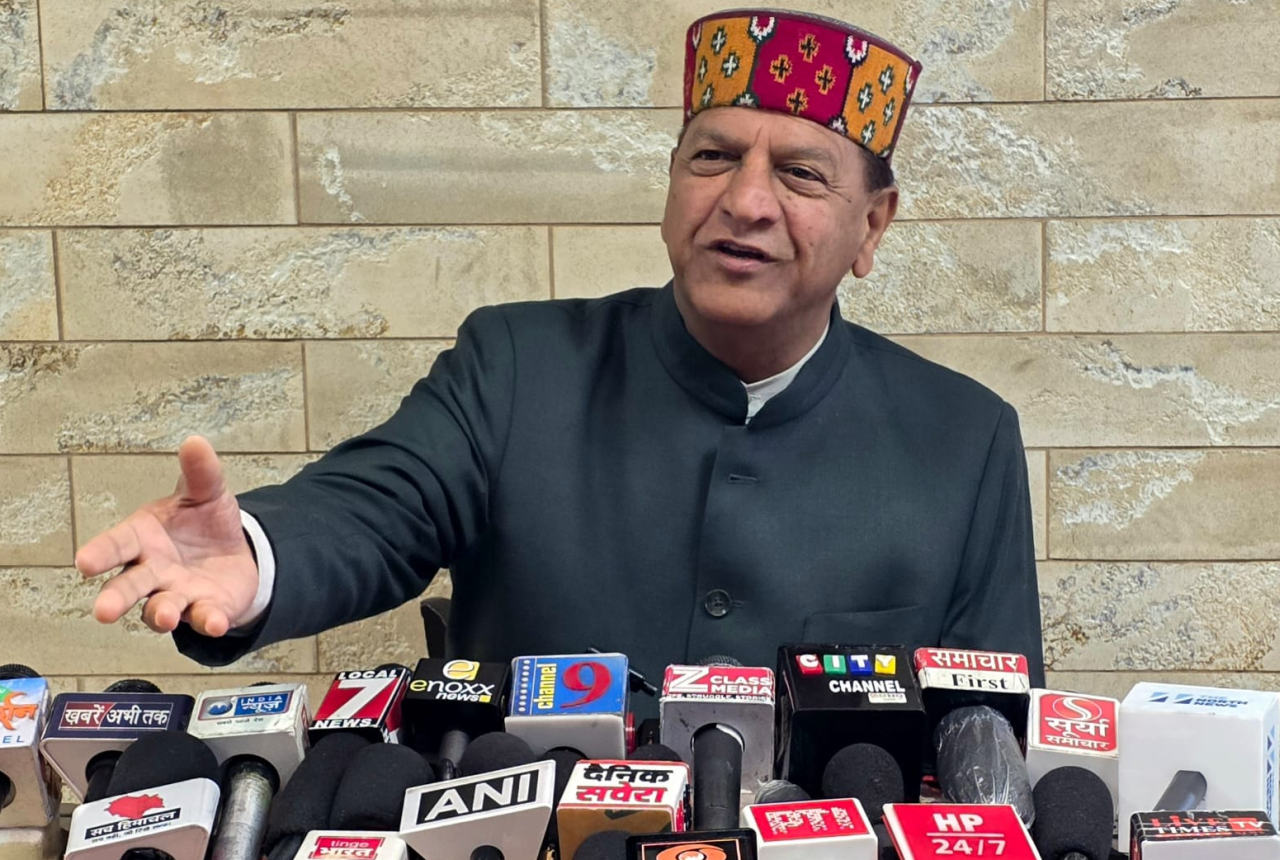
Shimla: The Bharatiya Janata Party (BJP) has launched a sharp attack on the Congress government in Himachal Pradesh over the imposition of a 60-paise-per-litre cess on petrol and high-speed diesel, accusing the Sukhvinder Singh Sukhu-led government of repeatedly increasing the financial burden on the people through taxes, cesses and higher charges.
BJP State President Dr. Rajeev Bindal and State Chief Spokesperson and MLA Rakesh Jamwal criticised the decision, saying the latest fuel price increase would have a cascading impact on households, farmers, horticulturists, transporters, traders and businesses across the state.
Dr. Bindal said the Congress government had made it a policy to continuously burden the people with taxes, levies and inflation. He said the latest 60-paise-per-litre increase in petrol and diesel prices was another blow to the common man’s pocket and deserved to be condemned.
According to Bindal, the financial burden on consumers has increased repeatedly since the Congress government assumed office. He alleged that the government had increased VAT on diesel soon after coming to power and subsequently introduced further tax and levy increases under different heads.
Jamwal elaborated on the diesel VAT increases, stating that the government raised VAT on diesel by around ₹3 per litre in January 2023, taking it from approximately ₹4.40 to ₹7.40 per litre. In July 2023, the VAT was increased by another ₹3 per litre, taking it to around ₹10.40 per litre.
“Thus, in 2023 alone, the Congress government increased the VAT burden on diesel by approximately ₹6 per litre in two stages. Now, it has gone a step further by imposing a fresh 60-paise-per-litre cess on both petrol and high-speed diesel,” Jamwal said.
He also pointed to the increase in the Additional Goods Tax on cement, saying it had been raised from ₹11 to ₹16 per bag, adding another ₹5 to the cost of construction material.
Fuel Hike to Push Up Transportation Costs
The BJP leaders said the impact of the latest fuel cess would extend far beyond consumers purchasing petrol or diesel at filling stations. In a mountainous state such as Himachal Pradesh, where road transportation plays a crucial role in the economy, any increase in fuel prices can raise freight and transportation costs.
According to the BJP, higher diesel prices could increase the cost of transporting cement, steel, sand, gravel, food grains, fruits, vegetables and other essential commodities. Taxi fares and other transport services could also come under pressure.
Bindal said farmers and horticulturists would be particularly affected because petrol and diesel are extensively used for agricultural and horticultural machinery as well as for transporting produce from farms and orchards to markets.
Jamwal said the increased fuel cost, coupled with the higher tax on cement, could create a double burden for families undertaking construction.
“First, the government increased the tax burden on cement itself, and now it is increasing the cost of the fuel used to transport cement, steel and other construction material. Ultimately, it is the common citizen who has to pay for this double burden,” he said.
BJP Questions Government’s Tax Policy
The BJP leaders also alleged that the government’s policy of increasing the financial burden was not restricted to petroleum products. They cited repeated increases in electricity tariffs and various charges, along with the reduction of electricity subsidies, saying these measures were affecting domestic consumers, traders and small-scale industries.
Bindal said that instead of providing relief to people already facing economic difficulties, the government was imposing fresh financial burdens.
Jamwal said the BJP supported welfare measures for vulnerable sections of society, including orphans and widows, but questioned the government’s decision to finance such initiatives through an additional burden on fuel consumers.
“Welfare of orphans and widows is a sensitive and important responsibility of the government. But every welfare programme cannot become an excuse to impose a new tax or cess on the people. The government must improve its financial management instead of repeatedly reaching into the pockets of ordinary citizens,” Jamwal said.
‘Sukh Ki Sarkar’ Has Become ‘Bojh Ki Sarkar’
The BJP leaders said the Congress had come to power promising a government of relief and welfare, but its economic decisions were increasingly turning that promise on its head.
Jamwal described the government as a “Bojh Ki Sarkar” (government of burden) instead of the promised “Sukh Ki Sarkar” (government of happiness).
“Whenever this government faces a financial challenge, its solution appears to be the same—increase VAT, impose a cess, raise a tax or increase a fee. The people of Himachal were promised relief, but they are repeatedly receiving fresh financial shocks,” he said.
The BJP said the latest fuel cess would ultimately have a wider inflationary impact on the state economy and urged the government to reconsider its approach of repeatedly increasing taxes and levies on ordinary citizens.