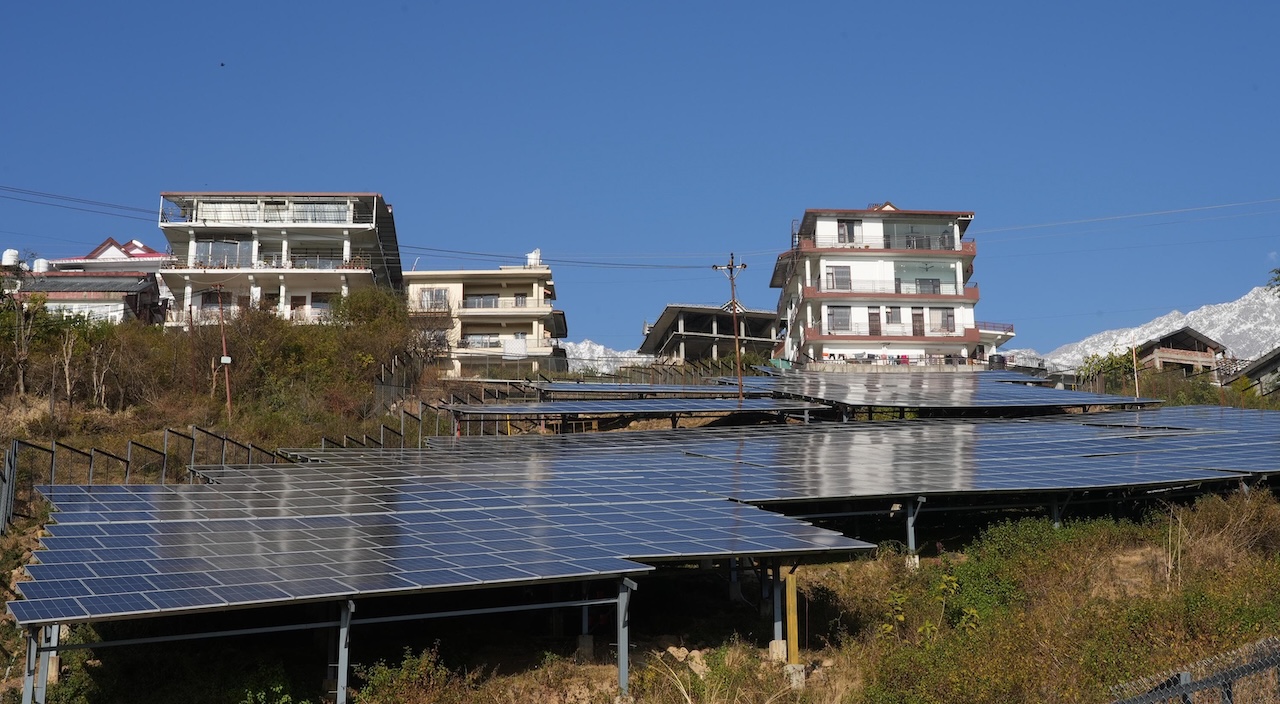
Shimla: Himachal Pradesh is moving ahead with an integrated push to expand solar, hydropower and emerging green fuel projects, as the state government works towards meeting over 90 percent of its energy needs from renewable sources. With annual power consumption estimated at around 13,000 million units, the strategy aims to position the state as a model of energy self-reliance and sustainable development.
The government has accelerated efforts to tap the state’s vast potential in hydropower and solar energy. Officials said the focus is not only on meeting internal demand but also on generating surplus clean energy for other states.
In the hydropower sector, emphasis is being laid on small projects of up to 5 MW capacity. Over the past three years, seven such projects with a total capacity of 17.25 MW have been initiated, while 12 projects totalling 23.80 MW have been completed. Another 18 projects with a capacity of 47.90 MW are awaiting approval. In addition, five projects of 12.65 MW have received technical clearance, and expansion agreements have been signed for seven projects of 25.7 MW. Authorities are also processing 76 new applications with a combined capacity of 75 MW.
Solar energy development forms a major part of the state’s plan. The government has proposed five solar parks with a total capacity of 501 MW, along with additional projects of 212 MW. A large 200 MW solar power plant is also planned in Damtal in Kangra district on barren land.
Several solar projects, including those at Pekhubela, Bhanjal and Aghlor, have been completed in a short span. A total of 728.4 MW capacity has been allotted to Himachal Pradesh Power Corporation Limited, with 120 ground-mounted projects of 150.13 MW already under implementation.
To streamline project allocation, the state has adopted a “First Come, First Serve” policy for solar projects ranging from 250 KW to 5 MW. Power generated from these projects will be purchased by the Himachal Pradesh State Electricity Board. So far, 547 investors have been allotted projects totaling 595.97 MW, with power purchase agreements signed for 403.09 MW.
At the grassroots level, the Green Panchayat Programme is being rolled out, under which 500 KW solar plants will be installed in panchayats across the state. Notably, 20 percent of the revenue generated will be used to support orphans and widows in the respective gram panchayats.
The government is also focusing on ensuring a reliable power supply in remote areas. Battery Energy Storage Systems are being installed in Hilor and Dharwas villages in Pangi (Chamba district), while solar off-grid systems have been provided to 148 households in remote villages of Lahaul and Spiti, including Mudh, Langza, Hikkim and Komic. A 2 MW solar plant has also been set up in Kaza.
Beyond conventional renewables, the state is exploring green fuel technologies. A green hydrogen-based mobility station is being established in Chamba, while a 1 MW green hydrogen plant is planned in Nalagarh in Solan district. Efforts are also underway to promote compressed biogas and tap geothermal energy.
In Hamirpur district’s Neri, the state has initiated work on what is being described as the country’s first state-supported biochar plant, marking another step towards cleaner energy alternatives.
Officials said the integrated approach—covering solar, small hydro, green hydrogen and other alternative energy sources—will help reduce dependence on conventional power while addressing environmental concerns and creating new economic opportunities in the state.