
Mandi: Nearly nine years after the devastating Kotropi landslide that claimed 46 lives, a new scientific study by researchers at the Indian Institute of Technology (IIT) Mandi has warned that the mountainside along National Highway-154 in Mandi district remains critically unstable and could witness another major collapse if urgent mitigation measures are not undertaken.
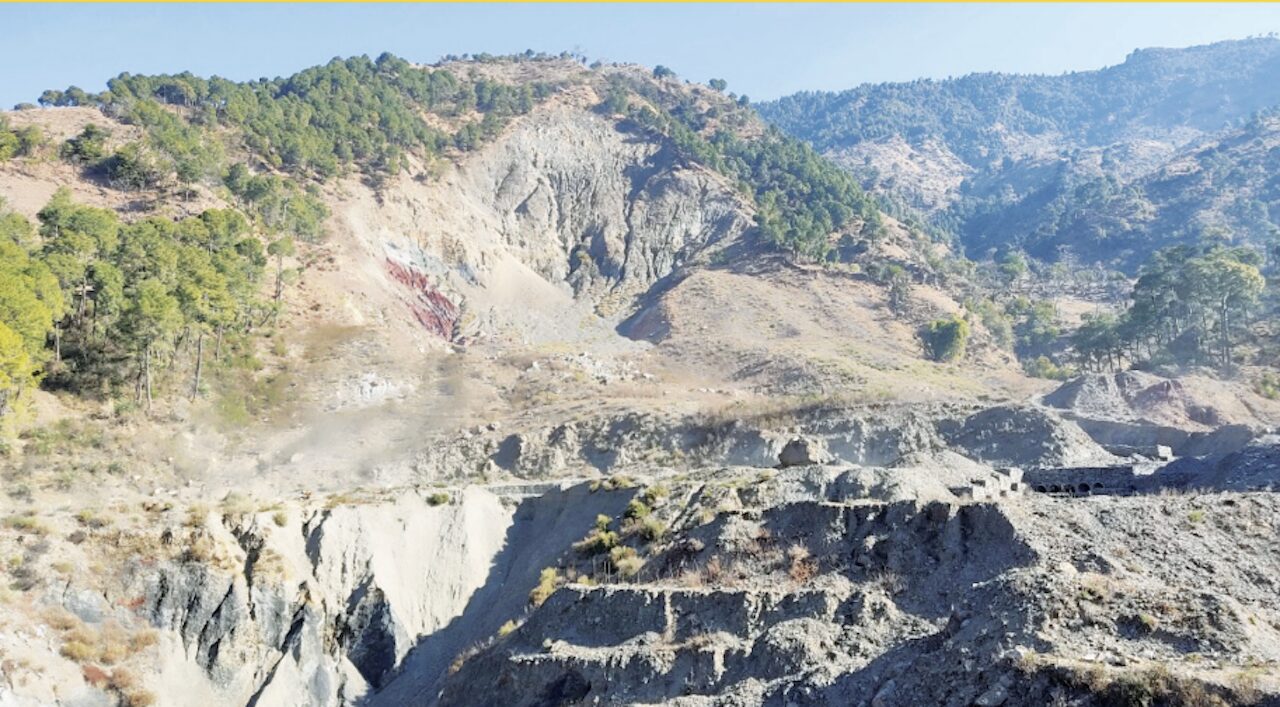
The findings, published on June 27 in the journal Scientific Reports, part of the Nature Portfolio, indicate that the right flank of the Kotropi landslide zone has reached an alarming level of instability. Researchers found that the Factor of Safety (FoS)—a key engineering indicator used to assess slope stability—ranges between 0.35 and 0.50 in the most vulnerable section. In slope engineering, an FoS below 1.0 signifies that a slope is unstable and susceptible to failure.
The study further revealed that all seven slope profiles analysed at the site recorded a Factor of Safety below 1.0, suggesting that the entire mountainside has been structurally weakened and remains vulnerable to future landslides.
The latest warning revives memories of one of Himachal Pradesh’s worst natural disasters. On the night of August 13, 2017, following days of intense monsoon rainfall, a massive landslide struck the Kotropi area on the Mandi–Pathankot National Highway (now NH-154). Two Himachal Road Transport Corporation (HRTC) buses travelling on the highway were buried under thousands of tonnes of debris.
The disaster claimed 46 lives, while several others were injured. Rescue operations continued for days amid unstable terrain and adverse weather conditions. Since the tragedy, the Kotropi slope has remained geologically active, with repeated instances of falling debris, smaller landslides and periodic highway closures during the monsoon season.
Geological Faults Behind the Repeated Landslides
According to the IIT Mandi study, the recurring instability at Kotropi is not solely the result of heavy rainfall but is rooted in the area’s complex geological structure.
Researchers identified the Main Boundary Thrust (MBT)—a major Himalayan tectonic fault separating the Lesser Himalayas from the Shivalik ranges—as one of the principal causes of the slope’s instability. Continuous tectonic movements along the fault have weakened the rock mass over time.
The study also highlights several additional factors contributing to the recurring landslides, including:
- Unfavourable orientation of rock layers;
- Extensive fractures, joints and deep fissures within the mountain;
- Weathered and weakened rock formations; and
- Heavy monsoon rainfall, which allows water to infiltrate these fractures, reducing the cohesion between soil and rock and significantly increasing the likelihood of slope failure.
Researchers noted that prolonged rainfall raises pore water pressure within the slope, further decreasing its stability and making collapse more likely during the monsoon months.
Advanced Technology Used for Assessment
The multidisciplinary research team employed a combination of advanced field and remote-sensing technologies to assess the slope’s condition.
The study involved high-resolution drone (UAV) mapping, German TanDEM-X satellite imagery, detailed geological field investigations and sophisticated computer-based slope stability simulations.
To validate the findings, researchers used both the Limit Equilibrium Method (LEM) and the Finite Element Method (FEM), internationally accepted techniques for evaluating slope stability.
The research team comprised Prof. Nitesh Dhiman, Prof. Ankit Singh, and Dericks Praise Shukla from the School of Civil and Environmental Engineering, IIT Mandi, along with Neeraj KC of Tribhuvan University, Nepal, and Prof. Sharad Kumar Gupta from the Helmholtz Centre, Germany.
Researchers said the study demonstrates that scientific intervention can substantially reduce the risk to life and infrastructure if implemented in time. The researchers have recommended a series of mitigation measures, including the construction of retaining and protective structures, installation of efficient surface and subsurface drainage systems to prevent water accumulation, continuous geotechnical monitoring of the slope, and long-term stabilisation works in the vulnerable section.
They stressed that engineering interventions, combined with real-time monitoring and timely maintenance, could significantly reduce the possibility of another catastrophic landslide.