Shimla: A major question is confronting thousands of government employees in Himachal Pradesh following the legal battle over counting contractual service towards seniority, promotions and other service benefits: Have employees who trusted government policies, accepted regularisation and never approached the courts been placed at a disadvantage compared to those who fought legal battles to secure their rights?
The controversy, which originated with the Taj Mohammad case, has now taken a new turn following the Himachal Pradesh High Court’s judgment striking down the Himachal Pradesh Recruitment and Conditions of Service of Government Employees Act, 2024, and the Supreme Court’s subsequent dismissal of the state government’s special leave petition and review petition.
The latest developments have prompted the state government to initiate the process of implementing the judicial directions and reviewing seniority lists and consequential service benefits. The Department of Personnel has circulated instructions to administrative departments to examine the applicability of the judgments, prepare revised seniority lists and undertake review or fresh Departmental Promotion Committee (DPC) proceedings wherever required.
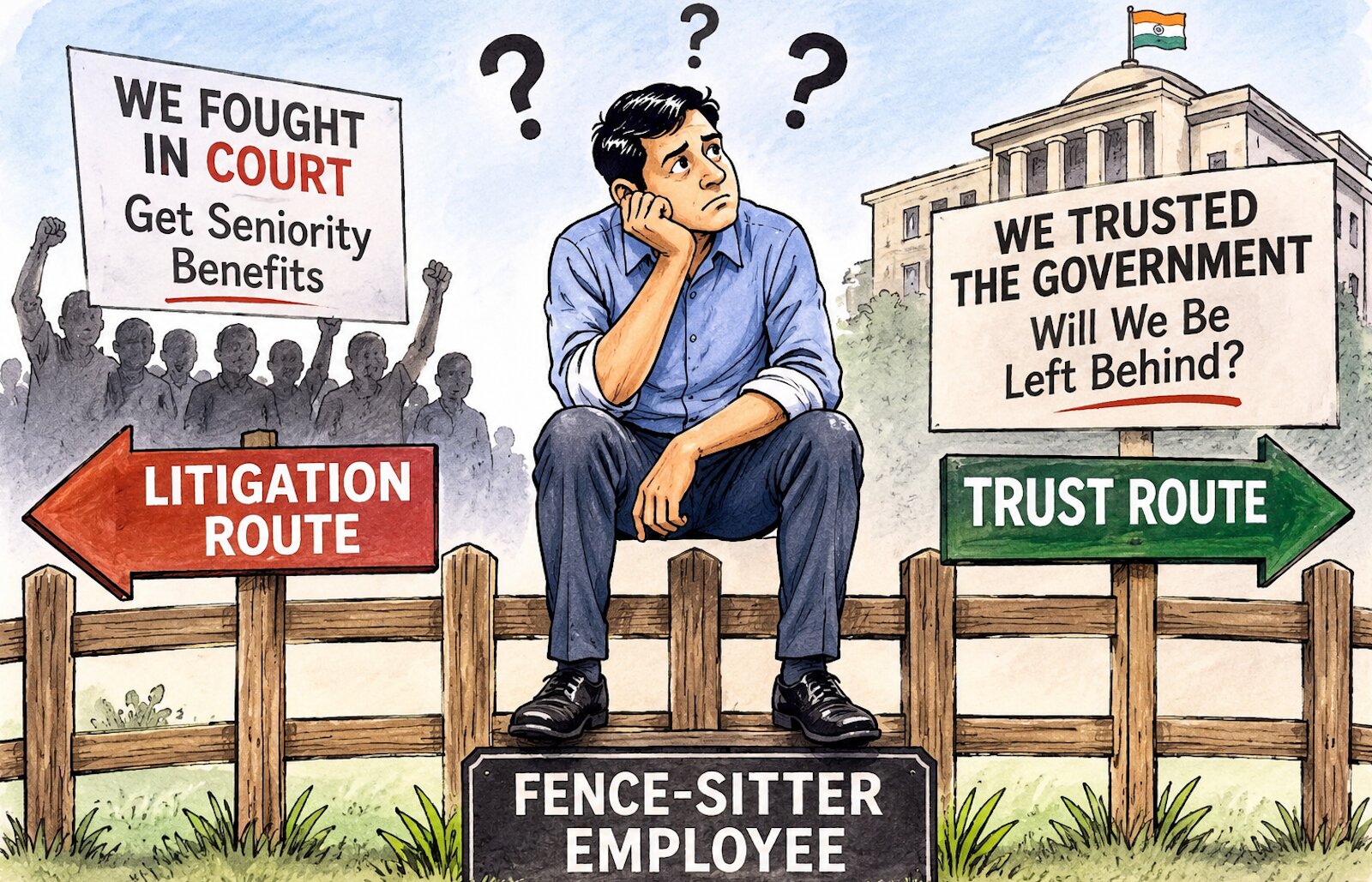
However, while the legal battle appears to have moved in favour of employees who successfully challenged the government’s position, another category of employees is now looking for answers: those who did not file cases, did not question their regularisation orders and continued working under the belief that the government’s service policies and seniority arrangements were final.
These employees are increasingly being described as ‘fence-sitters’. But the question is whether they deliberately waited for others to secure a favourable judgment or simply trusted the government and its established administrative arrangements.
Can employees be disadvantaged merely because they chose not to litigate? And can the government extend benefits to one category while leaving similarly placed employees outside the ambit of the relief?
Taj Mohammad case: How the issue began
The dispute traces its roots to the Himachal Pradesh High Court’s August 3, 2023, judgment in Taj Mohammad and Others versus State of Himachal Pradesh and Others.
The petitioners had initially been appointed on a contractual basis, but their selection had been conducted through the prescribed recruitment procedure under the applicable Recruitment and Promotion Rules. They argued that once their services were regularised, their contractual service should also be counted for seniority and consequential service benefits.
The court accepted their claim, relying on the nature of the recruitment process and the legal principles governing seniority. The judgment became an important precedent for contractual employees who had been selected through the prescribed procedure but were offered contractual appointments instead of regular appointments.
The underlying issue was that two sets of candidates could have undergone the same selection process, competed for the same sanctioned posts and fulfilled the same eligibility requirements, yet received different appointment terms, with one being appointed regularly and another on contract.
The employees argued that this difference in appointment status should not deprive them of the benefits of their qualifying contractual service after regularisation.
The judgment consequently opened the way for similar claims by contractual employees across government departments.
Government brings legislation, but High Court strikes it down
The state government subsequently enacted the Himachal Pradesh Recruitment and Conditions of Service of Government Employees Act, 2024, seeking to regulate recruitment and service conditions and restrict the extension of certain benefits for contractual service.
The government maintained that counting contractual service towards seniority could disturb long-established seniority lists, affect employees who had already received promotions and create substantial financial liabilities.
It also argued that contractual appointments and regular appointments were legally different and that employees had accepted regularisation under conditions that did not promise retrospective seniority.
However, employees challenged the legislation, arguing that the government could not use a new law to neutralise judicial decisions recognising their service rights.
On April 25, 2026, the Himachal Pradesh High Court, in Devinder Kumar and Others versus State of Himachal Pradesh and Another, struck down the 2024 legislation.
The government challenged the decision before the Supreme Court, but its special leave petition was dismissed on July 29, 2026. The Supreme Court subsequently rejected the government’s review petition, with the dismissal recorded on October 29, 2026.
The government’s legal setback has now implemented the judicial directions, a major administrative challenge.
Government’s November 6 instructions: Seniority lists to be revised
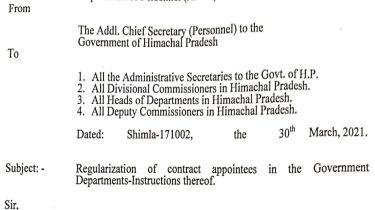
The issue has become more complicated following the Department of Personnel’s communication issued on November 6, 2026, directing departments to initiate the process of implementing the court verdict.
According to the instructions, departments have been asked to identify the applicability of judicial decisions to individual cases, circulate tentative seniority lists, finalise revised seniority positions and conduct review or fresh DPC meetings wherever necessary.
The exercise could have far-reaching consequences. Employees whose contractual service is counted may move up in the seniority list, potentially becoming eligible for promotions earlier than colleagues who were previously placed above them.
At the same time, employees whose seniority position declines may face a review of their earlier promotions. The government has provided for review of previous DPC proceedings and fresh consideration of employees who become eligible for promotion following revision of seniority.
However, the instructions also clarify that promotions will ordinarily be prospective or effective from the date of assumption of charge. Monetary benefits arising from revised seniority and promotion proceedings will generally be notional unless a competent court has specifically ordered otherwise. No supernumerary posts will be created to accommodate the resulting adjustments.
This means that the implementation exercise could affect not only contractual employees seeking retrospective seniority but also regular employees who have already secured promotions and established their positions in the departmental hierarchy.
Jameet Singh judgment: The ‘fence-sitter’ issue becomes critical
An important legal complication comes from the Supreme Court’s August 11, 2026, judgment in State of Himachal Pradesh versus Jameet Singh.
In this case, the Supreme Court examined claims by employees who had approached the courts after considerable delay, seeking benefits granted under earlier judicial decisions.
The court observed that employees who remained inactive for years and approached the appropriate judicial forum only after a favourable judgment had been delivered in similar cases could not ordinarily claim the benefit of that subsequent development without explaining the delay.
The respondents in that case had approached the court more than 12 years after the cause of action arose. The Supreme Court held that their conduct could not be regarded as bona fide and set aside the High Court’s order that had expanded the relief available to them.
The judgment is particularly relevant because it establishes that the concept of ‘fence-sitters’ cannot be ignored in service matters. Employees who consciously refrain from pursuing available remedies for years cannot automatically claim every benefit subsequently secured by other employees.
However, the Jameet Singh ruling arose from a different service-benefit dispute involving pay scales and execution of an earlier court order. It should not be interpreted as an automatic rejection of every non-litigating employee’s claim in the contractual-service controversy. The facts, cause of action, applicable judgment and explanation for delay must be examined individually.
The November 6 departmental instructions have specifically referred to the Jameet Singh judgment while dealing with employees who did not approach the appropriate judicial forum at the relevant time. Their claims are to be considered in accordance with the legal principles laid down by the Supreme Court.
This creates a particularly difficult situation for employees who never challenged their contractual appointment or regularisation conditions because they believed the government’s policies would protect their service interests.
Did trusting the government become a disadvantage?
The most important question emerging from the entire controversy concerns the distinction between an employee who deliberately waited for a favourable judgment and one who genuinely believed that there was no need to approach the court.
For instance, an employee appointed on contract in 2008 through a prescribed selection process may have been regularised in 2015. If another employee appointed through the same selection process approaches the court and secures the benefit of counting contractual service towards seniority, should the first employee automatically be excluded simply because no writ petition was filed?
The answer may not be straightforward.
The Jameet Singh judgment makes clear that unexplained and excessive delay can defeat claims by fence-sitters. But it does not establish that every employee who did not litigate has necessarily forfeited an otherwise valid service entitlement.
There is a difference between an employee who knew about an available remedy and deliberately chose not to pursue it for years, and one who accepted the government’s regularisation policy in good faith and had no reason to anticipate that the policy would subsequently be declared unconstitutional.
There may also be employees who did not approach the courts because their contractual service was not disputed at the time, or because the government itself maintained that the existing service arrangements were legally valid.
Should these employees be treated on the same footing as those who deliberately waited for the outcome of litigation before making a claim?
This is a question that deserves careful consideration by the administration and, where necessary, judicial examination.
Another concern: Will revised seniority create new victims?
The controversy also has another side. Employees who were appointed regularly, or whose seniority was established under the prevailing rules, may now find themselves affected by retrospective changes.
Some may have already received promotions, while others may have been waiting for their turn. If contractual service is counted retrospectively, their relative seniority could change.
For example, an employee who was promoted to a higher post several years ago may find that a colleague, previously junior in the seniority list, is now placed above them after the contractual period is counted.
Although the government has prescribed a mechanism for review DPCs and adjustment of promotions, the practical consequences could be considerable.
The administration will have to balance the judicially recognised rights of contractual employees with the legitimate interests of employees whose service positions may be adversely affected.
It is equally important that no employee is deprived of an existing benefit without following the applicable service rules and principles of natural justice.
The revised seniority exercise, therefore, should not become a mechanical process of changing dates in service records. Every affected employee must be given clarity about the basis of the revision and an opportunity to raise objections in accordance with the applicable procedure.
A larger question of administrative fairness
The contractual-service controversy has exposed a long-standing problem in government recruitment policies. Employees were recruited through different arrangements, served for years on contractual terms and were subsequently regularised. The consequences of those arrangements are now being examined through a series of judicial decisions.
The government’s responsibility is not limited to implementing court orders in individual cases. It must also ensure that similarly situated employees are not subjected to arbitrary or inconsistent treatment.
If the recruitment process, sanctioned post, selection procedure and applicable service rules are identical, the administration must explain why one employee qualifies for a benefit while another does not. Equally, where an employee’s claim is barred by delay or does not fall within the category covered by a judgment, the reasons must be clearly recorded.
The state must also clarify whether the November 6 instructions envisage consideration of non-litigating employees on their individual merits or whether relief will largely remain confined to employees who secured specific judicial orders.
Questions that need answers
The latest developments leave several important questions unanswered:
- Will employees who never approached the courts but were recruited through the same prescribed selection process be considered for contractual-service benefits?
- Will all non-litigating employees be classified as fence-sitters, or will their individual circumstances and reasons for not approaching the courts be examined?
- How will the government distinguish between genuine fence-sitters and employees who relied on official regularisation policies in good faith?
- Can employees who never challenged their regularisation orders be denied seniority benefits even if their recruitment process is identical to that of successful petitioners?
- How will the interests of employees whose existing seniority and promotions are affected by retrospective revisions be protected?
- Will the government issue a uniform policy clarifying the position of litigants, non-litigants and employees whose claims may be affected by delay?
- What happens to employees who are close to retirement and may lose their opportunity for promotion while the exercise continues?
The real test will be equal treatment
The legal battle over contractual service has entered a new phase. The state government must now implement the judicial decisions while dealing with the complicated consequences of revised seniority, promotions and financial liabilities.
But the larger issue is whether the implementation process will deliver justice only to those who fought their cases or also examine the legitimate claims of employees who remained outside the courtroom.
The Jameet Singh judgment provides an important caution against belated claims by fence-sitters. At the same time, it should not become a blanket justification for denying consideration to every employee who did not litigate.
Employees who trusted government policies should not automatically be equated with those who deliberately waited for others to secure a favourable verdict.
Ultimately, the government must answer a fundamental question: if two employees were recruited through the same selection process, against comparable sanctioned posts and under identical service rules, should their seniority and career prospects depend entirely on who went to court and who chose to trust the government?
That is the real test of fairness in Himachal Pradesh’s contractual-service controversy.